
* In the early 1960s, various European air forces began to consider their requirements for the coming decades. One of the results was the emergence of a new generation of jet trainers to replace such classic aircraft as the Lockheed T-33 and Fouga Magister. The two main rivals in this exercise turned out to be the British Aerospace "Hawk" and the Franco-German Dassault-Dornier "Alpha Jet".
At the outset, the Alpha Jet had a bit of a lead, but the Hawk would prove to be the winner in the race. However, the Alpha Jet was built in good numbers and served with a number of air forces for several decades. This document provides a history and description of the Alpha Jet, as well as the Argentine "FMA Pampa", a more modest jet trainer with some roots in the Alpha Jet design. A list of illustration credits is included at the end.
* In the early 1960s, the British and French began a collaboration on development of what was originally supposed to be a supersonic jet trainer / light attack aircraft. The end result of this collaboration, the SEPECAT Jaguar, proved to be an excellent aircraft -- but its definition had evolved in the interim, and the type emerged as a full-sized strike fighter. Two-seat variants of the Jaguar were used for operational conversion, not as advanced trainers as such.
That left the original requirement unfulfilled, and the French began discussions with West Germany for collaboration on filling the need. A joint specification was produced in 1968 -- the trainer was now subsonic, supersonic trainers having proven something of a dead end -- and a joint development and production agreement was signed in July 1969. The joint agreement indicated that each of the two nations would buy 200 machines, each assembled in their own country. Proposals were generated by three groups of manufacturers:
All the proposals were to be powered by twin SNECMA-Turbomeca Larzac turbofans. The German Air Force, the Luftwaffe, had insisted that the trainer have two engines after suffering severe attrition from accidents with their single-engine Lockheed F-104 Starfighters.
The Breguet-Dassault-Dornier TA501 was declared the winner of the competition in July 1970, with full development approved in February 1972. Two prototypes were to be built by Dassault in France, that company having bought out Breguet in the meantime, and two were to be built by Dornier in Germany. The first French prototype performed its initial flight at Istres on 26 October 1973, with the first German prototype following from Oberpfaffenhofen on 9 January 1974. The remaining two prototypes were in the air before the end of 1974.
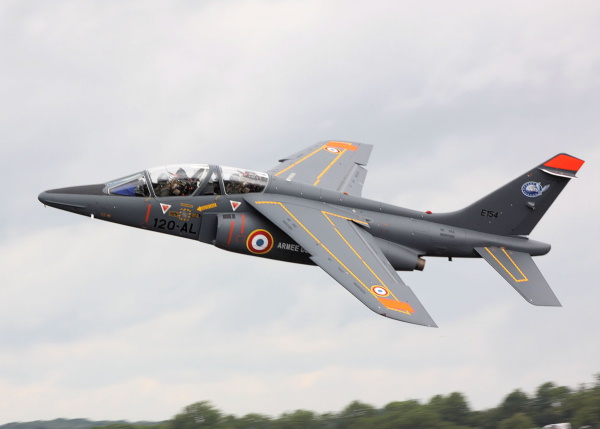
The French Air Force (the Armee de l'Aire / AA) decided to use the Alpha Jet primarily as a trainer; the first production Alpha Jet for the AA performed its initial flight on 4 November 1978. The AA variant was known as the "Alpha Jet E" (with "E" standing for "Ecole / School"), or "Alpha Jet Advanced Trainer / Light Attack" aircraft. Initial deliveries to the AA for service trials were in 1978, leading to introduction to line service in May 1979, replacing the Lockheed / Canadair Silver Star T-33 in jet training and the Dassault Mystere IVA in weapons training. 176 production Alpha Jet E machines were delivered up to 1985, not the 200 that had been planned.
The Luftwaffe decided to use the Alpha Jet in the light strike role, preferring to continue flight training in the sunny US southwest on American trainer types, instead of performing training in cloudy Germany. The first production German Alpha Jet performed its initial flight on 12 April 1978. It was designated the "Alpha Jet A" (where "A" stood for "Appui Tactique / Tactical Strike") or "Alpha Jet Close Support" variant.
The Luftwaffe obtained 175 machines up to 1983, with the type replacing the Fiat G91R/3. Although Alpha Jets were built in both France and Germany, manufacture of subassemblies was partitioned between the two countries, with plants in each country performing final assembly and checkout. The four prototypes remained in service as testbeds, for example evaluating a composite graphite-epoxy wing and improved Larzac engine variants.
BACK_TO_TOP* The Alpha Jet was a pretty little aircraft, with:
The tandem-seat cockpit featured separate clamshell-type canopies hinged at the rear. The French Alpha Jet E was fitted with Martin Baker AJRM4 ejection seats, while the German Alpha Jet A was fitted with UPC / Stencel S-III-F3 ejection seats. The rear seat was prominently raised, giving the instructor in the back seat a good forward view. There was a baggage compartment in the tail for hauling personal kit when flying to a remote airfield.
The avionics fit of French Alpha Jets was basic, but the Luftwaffe machines were fitted with a relatively sophisticated nav-attack system, featuring a Lear-Siegler inertial navigation system (INS); a Litton Doppler navigation radar; and a Kaiser / VDO head-up display (HUD). The different avionics fit made French and German Alpha Jets easy to tell apart, with French machines featuring a rounded-off nose, while German machines had a pointed nose that gave them a waspish appearance.
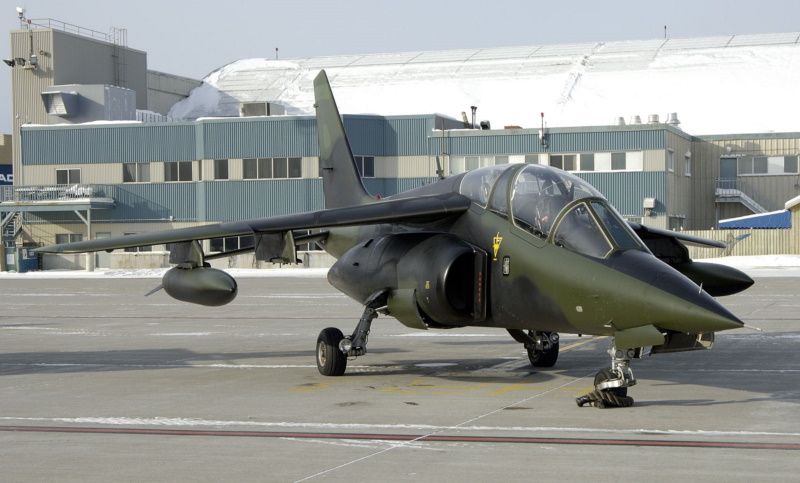
Although the Alpha Jet had no built-in armament, it could be fitted with a belly cannon pod. Luftwaffe cannon pods accommodated a single Mauser BK-27 27-millimeter cannon, while AA cannon pods accommodated a single DEFA 30-millimeter cannon with 150 rounds. Both French and German Alpha Jets were fitted with a gunsight.
The Alpha Jet could be fitted with twin stores pylons under each wing for a total of four pylons, with a total external load capability of 2,500 kilograms (5,500 pounds), impressive for the small size of the aircraft. Possible external stores included unguided rocket pods; iron bombs and cluster munitions; and two external tanks, with a capacity of 310 liters (82 US gallons) or 450 liters (119 US gallons) each. The Alpha Jet could carry heat-seeking air-to-air missiles (AAM) for self-defense, but it lacked a radar and so could not carry radar-guided AAMs. It could carry laser-guided bombs, though laser targeting had to be provided by ground forces or a spotting aircraft. The French qualified a film-camera pod, and the type could be used as a target tug.
   ___________________________________________________________________

   DASSAULT-DORNIER ALPHA JET E:
   ___________________________________________________________________

   wingspan:
     9.11 meters (29 feet 11 inches)
   wing area:
     17.50 sq_meters (188.37 sq_feet)
   length:
     11.75 meters (38 feet 6 inches)
   height:
     4.19 meters (13 feet 9 inches)

   empty weight:
     3,345 kilograms (7,375 pounds)
   normal weight:
     5,000 kilograms (11,025 pounds)
   MTO weight:
     8,000 kilograms (17,640 pounds)

   max speed at altitude:
     915 KPH (570 MPH / 495 KT)
   service ceiling:
     14,630 meters (48,000 feet)
   normal take-off run:
     370 meters (1,215 feet)
   normal landing run:
     500 meters (1,640 feet)
   operational radius (with wing tanks & high-altitude flight):
     610 kilometers (380 MI / 330 NMI)

   ___________________________________________________________________
Pictures of AA Alpha Jets showed them to feature a two-tone medium / dark green ripple camouflage pattern on top and single-tone gray paint underneath. Pictures of Luftwaffe aircraft showed them with a two-tone dark green ripple pattern overall.
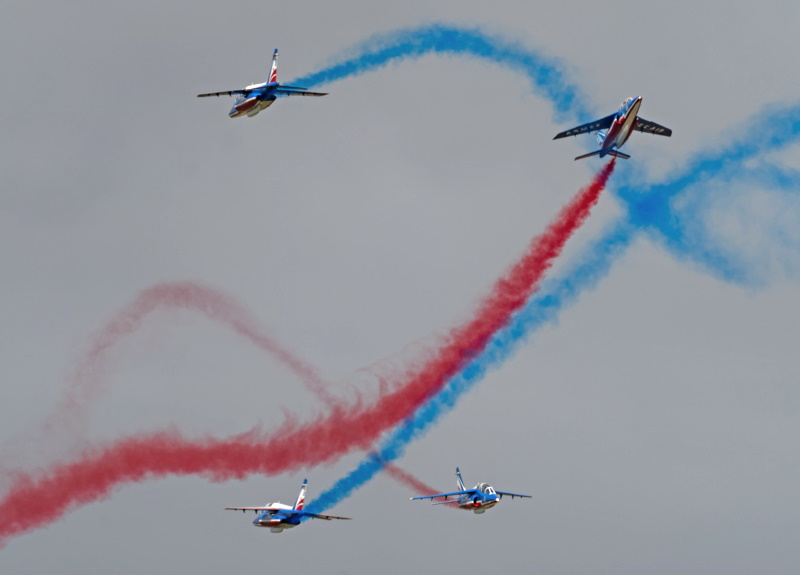
The Alpha Jet was said to be very agile and a good performer. It remains the current mount for the AA "Patrouille de France" flight demonstration team, which has operated the type since 1979. Of course, the Patrouille de France machines have spiffy aerobatic team colors.
BACK_TO_TOP* Considerable foreign sales were expected for the Alpha Jet, with the type becoming available before its main rival, the British Aerospace Hawk trainer and light strike aircraft. However, the Hawk ended up winning the competition without argument.
The first major foreign customers for the Alpha Jet were Belgium and Egypt, with both countries performing final assembly of French-configuration Alpha Jet E machines. Belgium ordered 33 aircraft under the designation of "Alpha Jet 1B", with assembly by SABCA of Belgium and deliveries in 1978:1980. They were used, at least informally, for public flight demonstrations, in flashy color schemes.
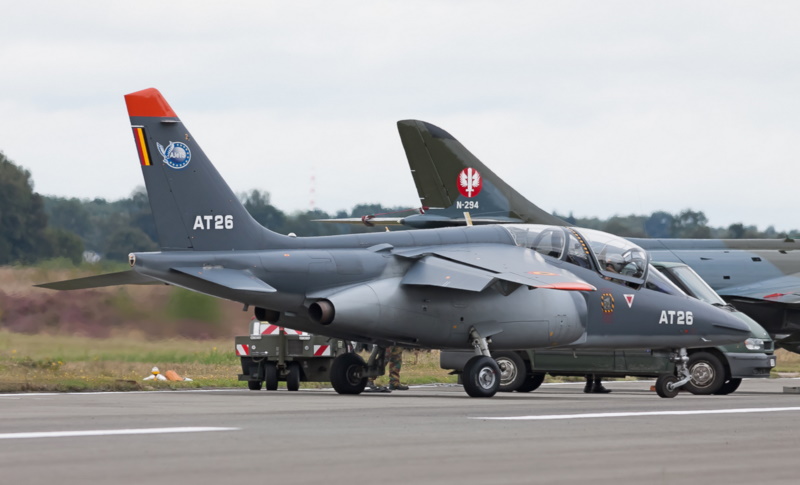
The survivors were updated by SABCA to "Alpha Jet 1B+" or simply "Alpha Jet +" configuration, featuring a laser-gyro inertial navigation system (INS) with a Global Positioning System (GPS) receiver; a HUD in the front cockpit, and a HUD repeater in the rear; a video recorder; and other small improvements. The initial "+" was redelivered in 2000; they were all finally retired in late 2019.
Egypt ordered 30 aircraft designated "Alpha Jet MS1" in the early 1980s. Four complete aircraft were supplied by Dassault, with the other 26 assembled in Egypt from knockdown kits by AOI.
A number of other nations also obtained the Alpha Jet E, including the Ivory Coast (7 aircraft); Morocco (24); Nigeria (24); Qatar (6 "Alpha Jet C"); and Togo (5). All of these machines were from French production -- except for the 24 Nigerian aircraft, which were obtained from German production. Pictures of Qatari Alpha Jet E machines showed them painted in neat brown-&-sand disruptive desert camouflage on top and light blue on the bottom, and also featuring an unusual long spine running from the tailfin up to about midwing. Moroccan Alpha Jets sported the same colors; three were kitted up for cloud-seeding, with a weather radar in a thimble nose radome, and chemical cartridges dispensed from an AN/ALE-40 chaff-flare dispenser.
The Luftwaffe began to phase out their Alpha Jet A machines in 1992, reserving 45 for lead-in fighter training. 50 were passed on to Portugal, with five of them used as spares hulks. Portuguese Alpha Jets flew with the "Asas de Portugal" flight demonstration team, which flew on an on-off basis.
The last Luftwaffe Alpha Jet left service in 1998. In 1999, 25 more were sold to Thailand to replace OV-10 Broncos in the border patrol role, while the British Defense Evaluation & Research Agency (DERA, now QinetiQ ) obtained 12 as chase planes, flight test platforms, and so on. Both the Thais and the British used five of their aircraft as spares hulks.
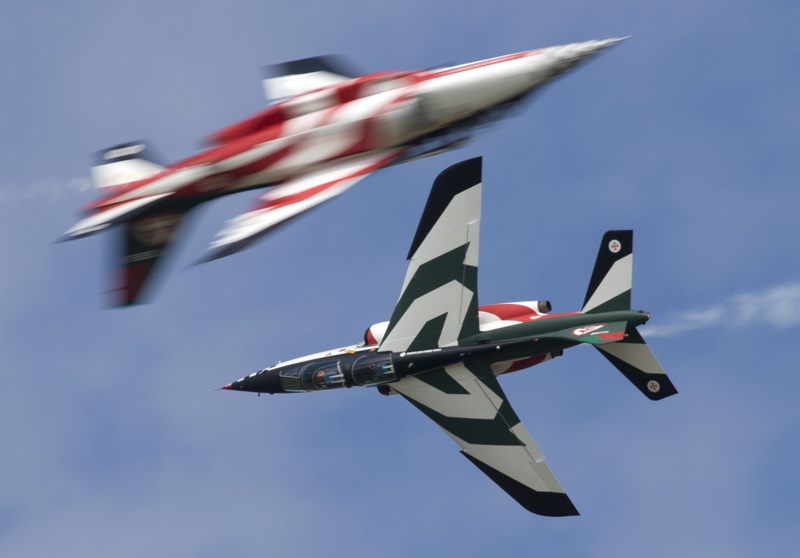
The Alpha Jets were sold at a rock-bottom price, since they were soaking up money simply sitting in mothballs; Fairchild-Dornier got a contract worth $43 million USD to refurbish the machines and provide support to the end users. Apparently 32 more, including two spares hulks, were sold to the United Arab Emirates (UAE), though details are unclear, while two ended up in Nigerian hands, after passing through a private buyer.
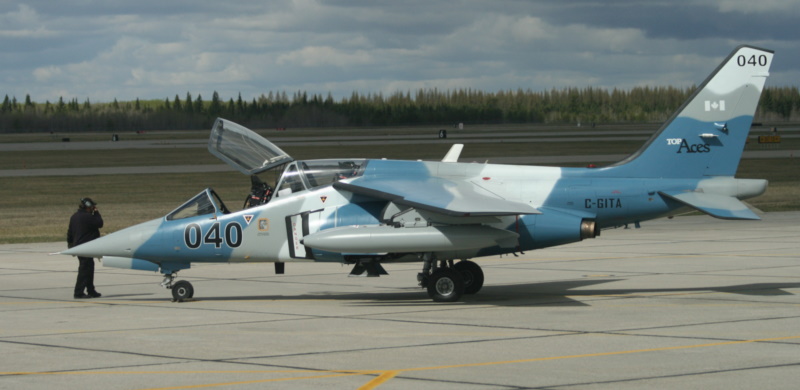
Three were obtained by the "Flying Bulls" flight demonstration team, which operates out of Austria and flies a range of classic aircraft. 16 of them were obtained by Discovery Air Defence Services (DADS) of Montreal, Canada -- now Top Aces -- primarily to provide combat support and adversary training for Canadian and other military forces. The Top Aces machines were painted in thoroughly military disruptive splinter camouflage schemes.
The Portuguese Alpha Jets were finally retired in early 2018. Portugal was then left without a fighter pilot training capability, with the decision made to contract training out to the US Air Force. Of the French Alpha Jets, 20 were updated to a "+" configuration similar to that obtained by Belgium, an additional feature of the French update being "hands on throttle & stick (HOTAS)" controls. The first updated AA aircraft was redelivered in 2011. French Alpha Jets were retired from training in 2023, being replaced by the Swiss Pilatus PC-21 -- but they remain in French service for adversary training, and with the Patrouille de France.
* In 1980, work began on an "Alternate Close Support" version of the Alpha Jet, featuring a SAGEM ULISS 81 INS; a Thomson-CSF VE-110 HUD; a TMV630 laser rangefinder in a modified nose; and a TRT AHV 9 radio altimeter, with all avionics linked through a digital databus. Initial flight was on 9 April 1982. Cameroon obtained 7 (some sources claim 6) and Egypt obtained 15. As with the original Egyptian order for MS1 machines, Dassault provided four such machines under the designation of "MS2", and AOI of Egypt assembled the other eleven from knockdown kits.
There were a number of other Alpha Jet proposals that never reached production:
RUAG of Switzerland offers support services for old Alpha Jets, as does Alpha Jets INC of the USA.
The disposition of the "recycled" Alpha Jets is dynamic and confusing. As mentioned, a set of them were obtained by Top Aces for adversary training. Air USA of New Mexico similarly flies Alpha Jets for adversary training; three are used by Australian forces for that role, while one is flown by the US National Aeronautics & Space Administration's (NASA) Ames center for tests and trials.
* A total of 506 Alpha Jets was built. Broken down by users:
There have been some retirements of these machines, but most remain in service.
BACK_TO_TOP* In 1979, the Argentine Air Force's Military Aircraft Factory (Fabrica Militar de Aviones SA / FMA) began work on the "IA-63 Pampa" jet trainer to replace the FMA-built Morane-Saulnier MS.760 Paris four-seat jet training / liaison / light attack aircraft in service in Argentina since 1958. FMA obtained assistance from Dornier on the project. Three flight and two static test prototypes were built, with the first flight prototype taking to the air for the first time on 6 October 1984. The Argentine Air Force had hoped to obtain 64 Pampas but only got 15, with deliveries from 1988 to 1990, with another delivered in 1999.
About seven different design concepts were considered during development. The final concept that was actually selected unsurprisingly had a clear resemblance to the Alpha Jet, and in fact the Pampa could be thought of as an "Alpha Jet Lite". From the side, the two types could be confused at a casual glance, and the Pampa had a landing gear arrangement and twin airbrakes much like those of the Alpha Jet.
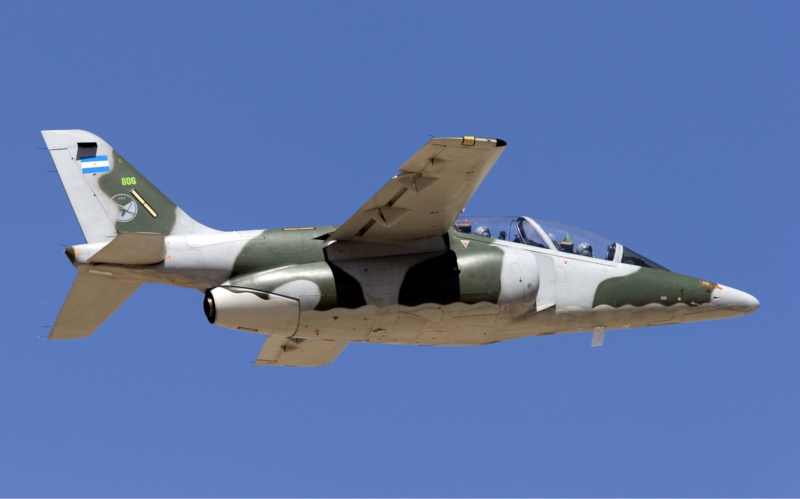
There were clear differences between the two machines as well. The Pampa was smaller than the Alpha Jet, with an empty weight only 84% as great, and it had straight wings and tailplane; a single-piece canopy; and most significantly, only a single engine, a US-built Garrett (now Honeywell) TFE731-2-2N turbofan with 15.57 kN (1,590 kgf / 3,500 lbf) thrust.
Like the Alpha Jet, the Pampa had four underwing pylons, but also had a centerline pylon. Its external load was smaller, restricted to 1,160 kilograms (2,560 pounds).
   ___________________________________________________________________

   FMA IA-63 PAMPA:
   ___________________________________________________________________

   wingspan:
     9.686 meters (31 feet 9 inches)
   wing area:
     15.63 sq_meters (168.27 sq_feet)
   length:
     10.93 meters (35 feet 10 inches)
   height:
     4.29 meters (14 feet 1 inch)

   empty weight:
     2,821 kilograms (6,219 pounds)
   MTO weight:
     5,000 kilograms (11,023 pounds)

   max speed at altitude:
     820 KPH (510 MPH / 440 KT)
   service ceiling:
     12,900 meters (42,325 feet)
   normal take-off run:
     425 meters (1,390 feet)
   normal landing run:
     460 meters (1,510 feet)
   range (internal fuel):
     1,500 kilometers (930 MI / 810 NMI)
   range (with tanks):
     1,850 kilometers (1,150 MI / 1,000 NMI)

   ___________________________________________________________________
* An improved "Pampa 2000" variant was developed for the US Joint Primary Aircraft Training System (JPATS) competition in the early 1990s. The second IA-63 prototype and two production machines were converted to the Pampa 2000 standard -- though the second prototype was lost in a crash in the UK on 31 August 1992, just before the Farnborough Air Show. One of the other Pampa 2000s performed a US demonstration tour in 1993, but the JPATS competition was actually won by the Beech-Pilatus T-6A Texan II.
In 1995, FMA was bought up by Lockheed Martin, which considered new development of the Pampa. A proposal to build a carrier-based version for the Argentine Navy went nowhere. In addition, FMA promoted an "AT-63 Pampa NG" for the light strike role, with seven stores pylons, larger intakes, stronger landing gear, inflight refueling probe, and combat avionics including radar or a laser rangefinder. A demonstrator was rolled out in 2004, but there were no buyers.
From 2003, Pampas in service were upgraded to the "Pampa II" standard, which included:
Six more machines built to the Pampa II standard were delivered from 2007 to 2008. The next step was to fit the Honeywell TFE731-40-2N engine, with 92 kN (9,370 kgf / 4,250 lbf) thrust, over 20% more than the original TFE731-2-2N powerplant. A "Pampa III" was rolled out in late 2013, featuring the TFE731-40-2N engine, as well as further improved avionics, including a full glass cockpit and a helmet-mounted display -- provided by Elbit of Israel. Pilots can also use night-vision goggles for night operations.
The first Pampa III prototype, it appears modified from the third original Pampa prototype, flew in 2015, with three production machines delivered to the Argentine Air Force in 2018. There was thought of obtaining 18, but only six were delivered in all, the last in 2020. Although primarily training assets, they had a secondary light attack capability, with their mission system permitting accurate attacks using dumb munitions. In addition, they could also be used to intercept air intruders, which are common in Latin America, thanks to drug smugglers and other miscreants.
BACK_TO_TOP* One of the footnotes of the Alpha Jet story is the Japanese Kawasaki T-4 trainer, used by the Japanese Air Self-Defense Force's "Blue Impulse" flight demonstration team. Although it would be an exaggeration to call the T-4 an Alpha Jet "clone", the two aircraft being generally different in detail, the Alpha Jet was clearly the model for the T-4's overall configuration. PZL Mielec of Poland also developed an Alpha Jet-like trainer, the "I-22 Iryda" -- but the program bogged down in technical and political difficulties, with only a handful built.
* Sources include:
Other small comments were obtained from various volumes of JANE'S ALL THE WORLD AIRCRAFT and various issues of WORLD AIR POWER JOURNAL / INTERNATIONAL AIR POWER REVIEW. The Alpha Jet is not an "over-documented" type.
* Illustrations details:
* Revision history:
   v1.0.0 / 01 nov 04
   v1.0.1 / 01 nov 06 / Review & polish.
   v1.0.2 / 01 oct 08 / Review & polish.
   v1.0.3 / 01 sep 10 / Review & polish.
   v1.0.4 / 01 aug 12 / Review & polish.
   v1.0.5 / 01 jul 14 / Pampa III.
   v1.0.6 / 01 jun 16 / Review & polish.
   v1.0.7 / 01 may 18 / Review & polish.
   v1.0.8 / 01 apr 20 / Review, update, & polish.
   v1.0.9 / 01 feb 22 / Review, update, & polish.
   v1.1.0 / 01 jan 24 / Review, update, & polish.
   v1.2.0 / 01 jan 26 / Review, update, & polish.
BACK_TO_TOP
