
* In the 1950s, the Fokker company of the Netherlands began studies for a twin-turboprop airliner, which emerged as the "Fokker F27" and became a worldwide success. It was followed by an improved derivative, the "Fokker 50". However, the Fokker twin turboprop airliners were eventually supplanted by new competitors -- one of the strongest being developed by Aerospatiale of France and Aeritalia of Italy as the "ATR 42", which was followed by a stretched derivative, the "ATR 72". This document provides a history and description of the F27, the F50, and the ATR 42/72. A list of illustration credits is included at the end.
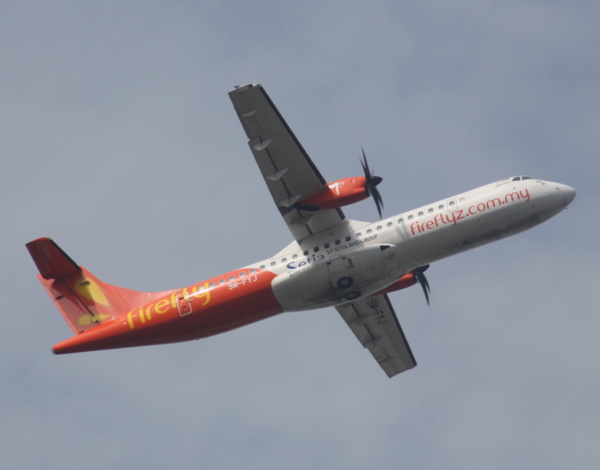
* In 1950, Fokker began investigation of a medium airliner powered by twin turboprop engines, then a new and innovative technology. The original design concept was known as the "P275" and featured twin Rolls-Royce Dart turboprops. With financial assistance from the Dutch government, Fokker went forward on development under a team by H.C. van Meerten, with the prototype of the "F27 Friendship" -- the designation also being rendered as "F.27" or "F 27" -- performing its initial flight on 24 November 1955. This first prototype was powered by Dart 507 engines providing 1,045 kW (1,400 SHP) each and driving four-bladed props; the aircraft had a length of 22.25 meters (73 feet) and a capacity of 28 passengers. It was later re-engined with Dart 511 engines, providing 1,145 kW (1,535 SHP) each. A second prototype followed in January 1957, with this aircraft powered by Dart 511 engines and stretched by 91 centimeters (3 feet) to handle 32 passengers. Initial flight of the first production "F27 Mark 100" was on 23 March 1958, with the type in service before the end of the year.
While working on bringing the F27 to service, Fokker set up a license production arrangement with Fairchild of the USA, with Fairchild flying the first "F-27" -- as the US variant was designated -- on 12 April 1958, and actually beating Fokker to initial production deliveries by a few months. The Fairchild F-27s differed from early Fokker-built F27 Mark 100 machines by having seating for 40 passengers, a longer nose with weather radar, and additional fuel capacity. Fokker adopted the Fairchild changes into F27 Mark 100 production as well.
* In response to customer feedback, the F27 Mark 100 / F-27 was quickly replaced in production by the "F27 Mark 200 / F-27A", which was similar to the Mark 100 version, but had increased fuel capacity and Dart 528 engines with 1,370 kW (1,835 SHP) each; later it went to the Dart 532-7, and then the Dart 536-7R, both delivering 1,530 kW (2,050 SHP), supporting higher take-off weights. The Dart was a shrill and noisy engine, with a hushkit introduced in the early 1980s to shut it up.
The F27 Mark 200 / F-27A provides a useful baseline for the series. The F27 was made mostly of aircraft aluminum alloy, with some use of glass fiber composite in noncritical structures. It featured high straight wings and a conventional tail arrangement with a prominent forward tailfin fillet. It had tricycle landing gear, the nose gear with a single wheel and retracting forward, and the twin-wheel main gear retracting back into the engine nacelles. The wings featured single slotted flaps -- one segment inboard of the engines, two outboard -- plus ailerons; the tail control surfaces were conventional. There were pneumatic de-icing boots on the leading edges of all flight surfaces.
There were two flight crew and one flight attendant. Avionics were conventional, including as mentioned a weather radar in the nose. As noted, normal passenger accommodations were 40 seats in a 4-across configuration, though up to 52 seats could be fitted in a high-density configuration. Of course, the aircraft was pressurized and climate-conditioned. There was a prominent scoop on each side of the fuselage just forward of the tail to provide air for the heat exchanger used in the climate-conditioning system.
There was a passenger door on the left rear fuselage -- either in a rear-sliding arrangement or configured as a drop-down "airstair", some sources claiming the airstair was distinct to Fairchild F-27 machines -- matched by a smaller door into the rear baggage area on the right. There was an emergency exit on each side of the fuselage at the rear of the wing. There was a door on the front left of the fuselage as well, though its configuration remains a bit confusing, it seems changing by variant.
There seems to have been a square inward-opening baggage door as standard for the Series 200; later the standard was a large cargo door up front that opened out and up, with a crew / passenger door inset forward on the cargo door, and hinged to open out and forward. The passenger windows were in the shape of vertical ovals, the oval form being seen as better able to stand up to pressurization / depressurization cycles than rectangular windows, the corners of which focused stress.
   ___________________________________________________________________

   FOKKER F27 MARK 200:
   ___________________________________________________________________

   wingspan:
     29 meters (95 feet 2 inches)
   wing area:
     70 sq_meters (753.5 sq_feet)
   length:
     23.56 meters (77 feet 4 inches)
   height:
     8.51 meters (27 feet 11 inches)

   empty weight:
     10,295 kilograms (22,695 pounds)
   MTO weight:
     20,410 kilograms (45,000 pounds)

   cruise speed:
     480 KPH (300 MPH / 260 KT)
   service ceiling:
     9,000 meters (29,500 feet)
   range, max payload:
     2,070 kilometers (1,285 MI / 1,120 NMI)

   ___________________________________________________________________
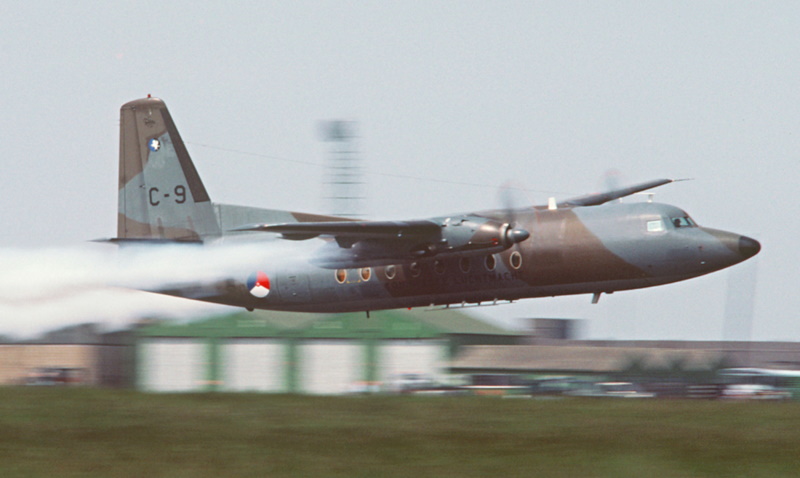
VIP configurations of the F27 Mark 200 / F-27A were produced along with airliner variants. Fokker developments included:
Fairchild introduced a roughly parallel series of refinements:
Fairchild did not build any combi variants or specifically military variants.
BACK_TO_TOP* The first series of Friendships proving a success, Fokker then introduced a second series with the "Mark 500", featuring a 1.5-meter (4 foot 11 inch) fuselage stretch to provide 52 seats, with high-density configurations cramming in 60 seats, along with Dart 532 engines. A militarized configuration, the "Mark 500M", was also built, with kit along the lines of the Mark 400M but with the stretched fuselage, permitting up to 60 paratroops or 30 stretchers. Fokker built a combi variant, the "Mark 600", as well.
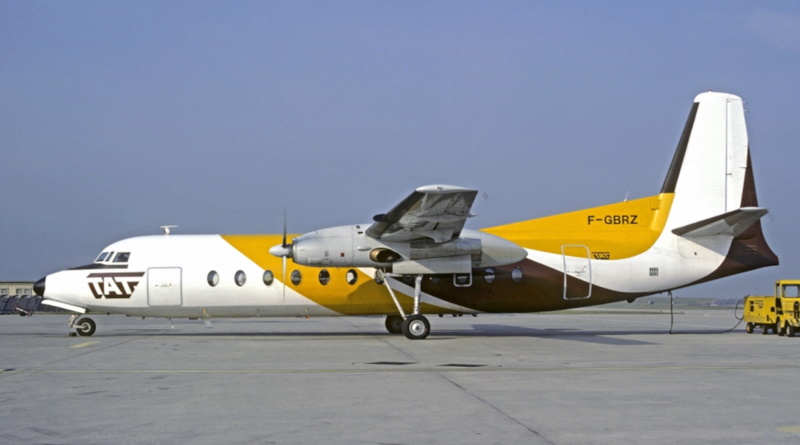
Fairchild -- more properly Fairchild-Hiller, following the acquisition of Hiller Helicopters in 1964 -- independently developed the stretched "FH-227", which appeared about two years before the Mark 500; it had a fuselage stretch of 1.83 meters (6 feet), and also had a capacity of 52 seats. It was produced in a series of subvariants:
* The Fokker F27 was built in special mission variants, one of the earliest being an aerial survey configuration with wide-angle cameras, initial flight being in 1973. It was followed by the "F27 Maritime Patrol Aircraft (MPA)" or "F27 MAR", an F27 being modified as the initial prototype to perform its first flight in 1976. Two subvariants were built:
The F27 Maritime Patrol Aircraft wasn't as popular as hoped, with about 15 sold to seven nations including Angola, the Netherlands, Nigeria, Peru, the Philippines, Spain, and Thailand. It couldn't meet competition with the US Lockheed P-3 Orion.
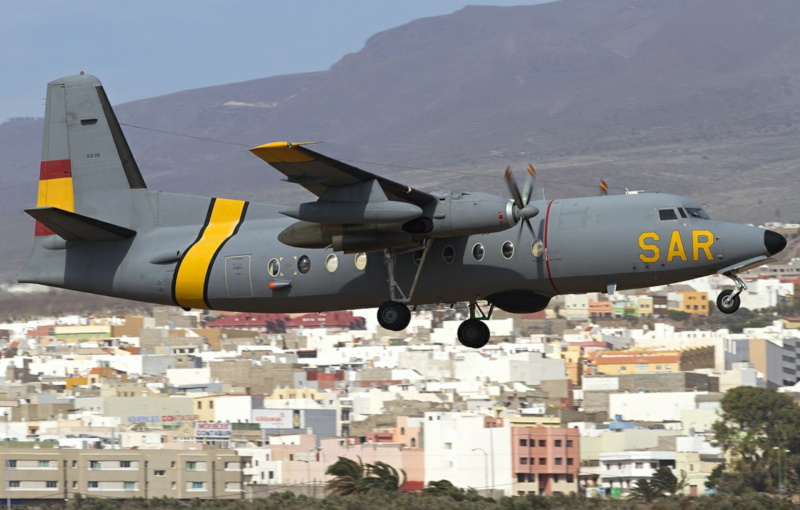
The F27 was also offered for the border patrol role as the "Sentinel", with a side-looking airborne radar (SLAR); for airborne early warning (AEW), with a retractable belly radome, as the "Kingbird"; and a signals intelligence (SIGINT) platform, as the "Black Raven", but nobody bought them -- Finland did operate a single F27 configured for SIGINT duties, but it appears it was a local conversion. Studies were performed on F27s with a tail loading ramp, four engines and short take-off capability, jet propulsion, and even a flying boat hull, but none of them happened either.
F27 production ended in 1987, after the manufacture of 786 aircraft, including 579 Fokker F27s, 128 Fairchild F-27s, and 79 Fairchild FH-227s. The F27 series lingered in service into the 21st century.
BACK_TO_TOP* In 1983, Fokker announced development of a much improved version of the F27, the "Fokker 50", which looked much like the F27 Mark 500 but was generally redesigned, having only limited parts compatibility with the F27. The most significant change was replacement of the first-generation Dart turboprops with Pratt & Whitney Canada (PWC) PW125 turboprops -- with 1,865 kW (2,500 SHP) and driving advanced six-blade propellers, as well as quieter operation and much reduced fuel consumption. Other changes included new avionics, including a cockpit "electronic flight instrumentation system (EFIS)"; some use of composite materials; small winglets or "Foklets" to reduce drag from wingtip vortices; and more passenger cabin windows, the windows becoming square instead of oval.
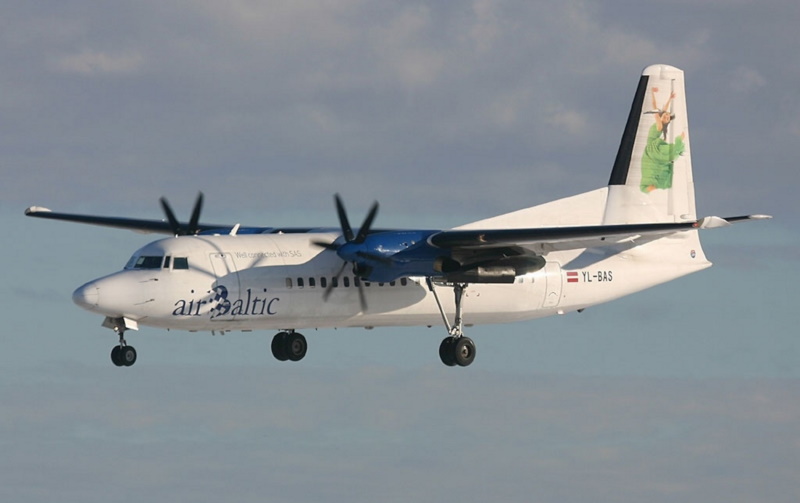
The two prototypes were actually based on F27 airframes, the first flying on 28 December 1985. The first production aircraft flew on 13 February 1987, with certification in May and initial customer deliveries in August of that year. The baseline Fokker 50 production model was the "Series 100"; a variant with three instead of four doors was designated the "Series 120". Fairchild never built the Fokker 50, the company going bankrupt in 1987.
   ___________________________________________________________________

   FOKKER F50 MARK 100:
   ___________________________________________________________________

   wingspan:
     29 meters (95 feet 2 inches)
   wing area:
     70 sq_meters (753.5 sq_feet)
   length:
     25.25 meters (82 feet 10 inches)
   height:
     8.317 meters (27 feet 4 inches)

   empty weight:
     10,650 kilograms (22,695 pounds)
   MTO weight:
     18,990 kilograms (41,865 pounds)

   cruise speed:
     520 KPH (325 MPH / 280 KT)
   service ceiling:
     9,000 meters (29,500 feet)
   range:
     1,250 kilometers (775 MI / 675 NMI)

   ___________________________________________________________________
A "Series 300" with enhanced "hot and high" performance using more powerful PW127B engines, providing 2,050 kW (2,750 SHP) each, was announced in 1990, with a four-door option sold as the "Series 320". Militarized variants were offered as well, including an "F50 Maritime Mark 2", "F50 Maritime Enforcer Mark 2", "F50 Sentinel Mark 2", "F50 Kingbird Mark 2", and "F50 Black Crow Mark 2". They didn't sell well, Singapore obtaining four Maritime Enforcer Mark 2s, and one Black Crow Mark 2 sold to an undisclosed customer.
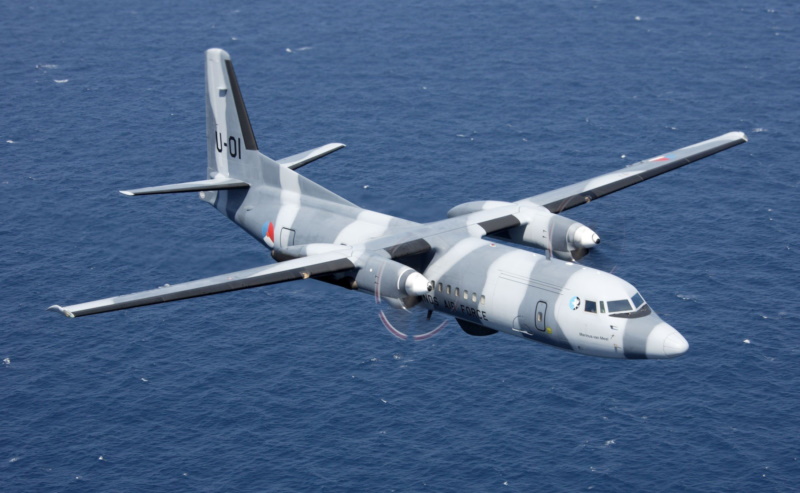
A "Fokker 60" was also built, this machine having a fuselage stretched by 1.62 meters (5 feet 4 inches); only four were made, the Royal Netherlands Air Force (RNLAF) obtaining them in a utility configuration. Two were then converted to a maritime patrol configuration, though they only flew for a few years before being mothballed, then sold off to Peru; Peru later obtained two F50s flown by the RNLAF, to be used as VIP transports. Fokker went bankrupt in 1996, with the last of 232 Fokker 50/60 series machines delivered in 1997.
BACK_TO_TOP* One of the contributing factors to the collapse of Fokker was the introduction of formidable competitors. In the late 1970s, Aerospatiale of France and Aeritalia of Italy -- Aerospatiale now being part of the Airbus Group, and Aeritalia now part of the Leonardo group -- had discussions on a joint effort to produce a regional airliner, the resulting collaboration being named "Avions de Transport Regional (ATR)".
ATR focused on a twin-turboprop configuration, the "ATR 42", with the 42 indicating the standard passenger seating capacity. The original variant was to be the "ATR 42-100", with 42 seats, but it never flew; there were two "ATR 42-200" prototypes, with 46 seats, the first flying on 16 August 1984; two static test prototypes were built as well. The initial "ATR 42-300" variant, with 50 seats, was certificated in 1985, entering service before the end of that year. Incidentally, all three of these variants were identical, only differing in increasing gross weight.
The ATR 42-300 was a straightforward twin-turboprop airliner with a high straight wing, a swept tailfin with a straight tee tailplane, and tricycle landing gear. The wing had double slotted flaps in two segments and an aileron -- plus a spoiler on top, just inboard of the aileron and forward of the outer flap segment. The tee tail assembly was conventional, with elevators and rudder, the only distinction being a forward tailfin fillet with a "cranked" sweep. Wing and tailplane de-icing was by pneumatic boots, while the windscreen was electrically de-iced.
Powerplants were Pratt & Whitney PW120 turboprops with 1,470 kW (2,000 SHP) max power each, driving four-bladed reversible Hamilton Standard propellers. A Garrett APU was optional. All fuel storage was in the wings. All landing-gear assemblies had two wheels, the nose gear retracting forward and the main gear retracting inward into fairings; the main gear had no door covers, leaving the wheels exposed in flight.
There were two aircrew, with a jumpseat for an observer. Avionics were conventional, including flight instrumentation, radios, radio navigation aids, identification transponder, and a weather radar in the nose. Passenger seating was in rows of four, with 42 seats as the baseline, along with higher-density configurations for 46, 48, or 50 seats; of course, the aircraft was pressurized and climate-conditioned. There was a cargo hold between the flight deck and the passenger cabin, along with a smaller hold at the rear of the cabin, this area also including galley, wardrobe, toilet, and seat for a flight attendant.
There was a passenger door on the left rear fuselage in the configuration of a fold-down airstair, with a matching service door / emergency exit on the right. There was an upward-hinging cargo door on the left forward fuselage for access to the forward baggage hold, with an emergency exit just to its rear on both sides. There was an emergency escape hatch on top of the cockpit as well.
   ___________________________________________________________________

   ATR 42-300:
   ___________________________________________________________________

   wingspan:
     24.57 meters (80 feet 8 inches)
   wing area:
     54.5 sq_meters (586.6 sq_feet)
   length:
     22.67 meters (74 feet 4 inches)
   height:
     7.59 meters (24 feet 11 inches)

   empty weight:
     9,975 kilograms (21,990 pounds)
   MTO weight:
     16,150 kilograms (35,605 pounds)

   cruise speed:
     500 KPH (310 MPH / 270 KT)
   cruise ceiling:
     7,620 meters (25,000 feet)
   range, max payload:
     1,195 kilometers (740 MI / 645 NMI)
   range, max fuel:
     4,615 kilometers (2,865 MI / 2,490 NMI)

   ___________________________________________________________________
An "ATR 42-320" was introduced that was similar but had more powerful PW121 engines, with 1,545 kW (2,100 SHP) each, for enhanced "hot and high" performance. The "ATR 42 Cargo" was a quick-change combi version of the ATR 42-300, capable of hauling 42 passengers or five cargo pallets, or combinations of loads in between. It appears to have retained the standard forward cargo door. A militarized cargo transport, the "ATR 42F", was built, but only one was sold.
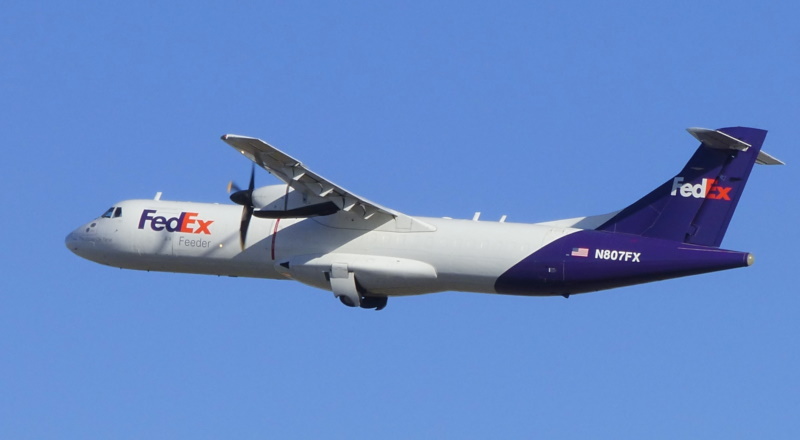
* In early 1986, ATR began work on a "stretched" version of the ATR 42, with the first of three "ATR 72" developmental machines performing its initial flight on 27 October 1988. Certification and initial service deliveries followed in 1989. There was thought of a further stretched "ATR 82", but it was a nonstarter.
The primary change in the ATR 72 relative to the ATR 42 was a 4.5-meter (14 foot 9 inch) fuselage stretch, as well as modified wings. The wings were new-design outboard of the engine nacelles, with an increase in span, and featured more composite assemblies. The ATR 72 was powered by PW124B turboprops with 1,610 kW (2,160 SHP) each. Standard passenger accommodations ranged from 64 to 74 seats. Other than those items, the ATR 72 was generally similar in detail to the ATR 42, not even featuring additional emergency exits.
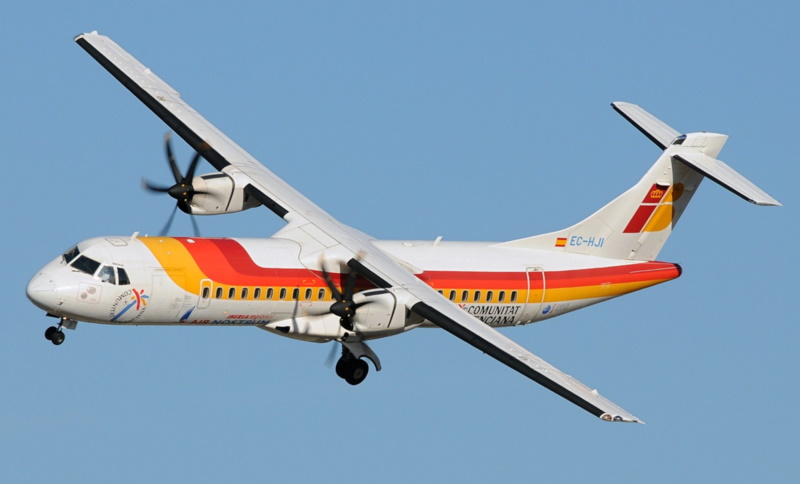
Along with the baseline ATR 72-200, ATR offered an "ATR 72-210", with more powerful PW127 engines -- with 1,850 kW (2,480 SHP) each -- for better "hot and high" performance. The initial series ATR 42 / 72 sold well. These early variants have been replaced in production by improved versions, but many of the older machines remain in service. From 2000, ATR offered freighter conversions for the ATR 42 and ATR 72, involving the installation of a large freight door and revising the cabin for freight handling.
BACK_TO_TOP* From the mid-1990s, the original ATR 42 and 72 variants were replaced in production by "Series 500" variants -- there was an interim "Series 400", but only two were built. The ATR 42-500 featured a new interior; new EFIS cockpit; more powerful PW-127E turboprops driving six-blade props; elevators and rudders developed for the ATR 72; as well as improved brakes and landing gear, plus reinforced wing and fuselage for handling higher take-off weights. Initial delivery was in 1995. An "ATR 72-500" was sold as well, though more officially it was the "ATR 72-212A", featuring higher MTO weights.
   ___________________________________________________________________

   ATR 72-500 (ATR 72-212A):
   ___________________________________________________________________

   wingspan:
     27.05 meters (88 feet 9 inches)
   wing area:
     61 sq_meters (656.6 sq_feet)
   length:
     27.17 meters (89 feet 2 inches)
   height:
     7.65 meters (25 feet 1 inch)

   empty weight:
     12,950 kilograms (28,550 pounds)
   MTO weight:
     22,500 kilograms (49,605 pounds)

   cruise speed:
     510 KPH (315 MPH / 275 KT)
   cruise ceiling:
     7,620 meters (25,000 feet)
   range:
     1,325 kilometers (825 MI / 715 NMI)

   ___________________________________________________________________
ATR went on to introduce "600 Series" machines, including the "ATR 42-600" and "ATR 72-600". They were powered by Pratt & Whitney 127M turboprops, providing greater reliability, lower fuel consumption, and more power over earlier powerplants. The 600 Series had a new avionics suite, with a modern multi-purpose computer (MPC) and a glass cockpit with five color flat-panel displays. Initial flight of the first 600 Series machine, an ATR 72-600, was in 2009, with the ATR 42-600 following in early 2010. Introduction to service was in 2011 for both machines. An air freighter option for the ATR 72-600, the "-600F", was introduced in 2017.
The ATRs have been updated in production, such as an optional electronic vision system, capable of aiding the cockpit crew in low-visibility conditions; an ADS-B system, providing collision warning and avoidance capability; an updated computer system and a smarter navigation system; new seats; and a new in-flight entertainment system. From 2022, ATR 42/72-600 has been built with PW127XT turboprops -- which were much more serviceable than the earlier engines, with incremental reductions in fuel consumption and emissions.
ATR has considered a short-field version of the ATR 42-600, with an eye to airlines serving islands with short runways in the Asia-Pacific region. The new variant will be able to operate from 800-meter (2,600-foot) runways. It will not be a major revision of the airframe, changes being made to operation of flaps, spoilers, rudder, and brakes -- plus reduction in weight through lighter seats and galley fittings.
The firm has tinkered with a "Green ATR 72" flight demonstrator, in accordance with the "Clean Sky Joint Technology Initiative (CS JTI)" initiative -- a public-private partnership between the European Union and Europe's aviation industries, intended to improve fuel economy, reduce emissions, and cut noise levels. The initial Green ATR 72 configuration tested new composite assemblies and fiber-optic vibration sensors, the sensors being intended to spot cracking and simplify maintenance. Other evaluations of new tech have been ongoing.
In 2022, ATR announced work on an "EVO" next-generation variant, clearly leveraging off the Green ATR 72 effort. The new design will include new engines capable of running "sustainable aviation fuel (SAF)", plus new propellers, upgraded systems, and an enhanced cabin with elements using lighter bio-sourced and recycled materials. Operational targets include a 20% lower fuel burn and a 20% overall reduction in maintenance costs, plus improved climb rate. It will enter service no earlier than 2030.
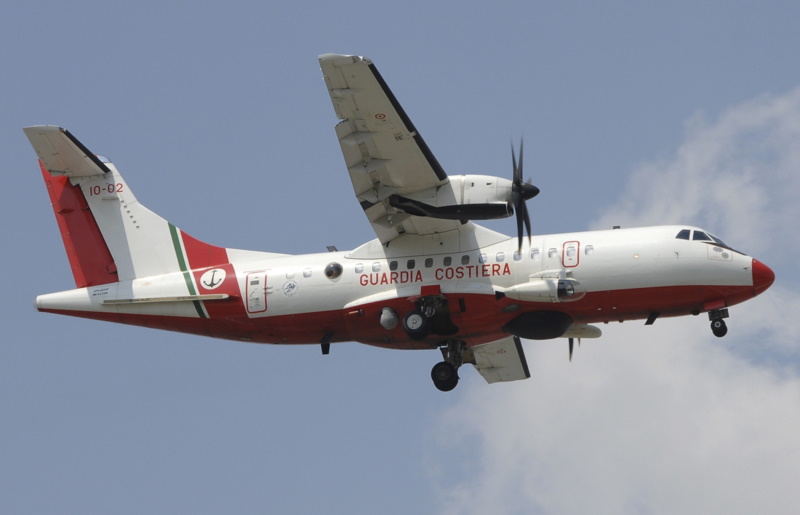
* There was talk of developing an "ATR 42-R" military cargolifter variant with a tail loading ramp, but it never happened. The firm has achieved success with military maritime patrol variants. The Italian Customs Police operate four "ATR 42 Maritime Patrol (ATR 42MP)" machines with a sensor suite. Nigeria also operates two ATR 42MP machines. At least one ATR 42 is in service with the US Special Operations Command (SOCOM), having been photographed carrying a sensor payload. As is usual with SOCOM aircraft, not much is said about it.
Six more sophisticated "ATR 72-600ASW" machines, along with two ATR 72-600 military utility machines, were ordered by the Turkish Navy, with deliveries of the utility machines in 2013, and first delivery of an ASW machine in 2016. The ATR 72ASWs are fitted with the "Airborne Tactical Observation & Sensor (ATOS)" system, built by Leonardo, with the suite including Ferranti Seaspray radar, an electro-optic sensor turret, magnetic anomaly detector sensor, and sonobuoy launcher. Military communications and datalink systems, as well as defensive countermeasures, were also fitted. They could carry two depth charges; four light torpedoes or two heavy torpedoes; or two Exocet antiship missiles.
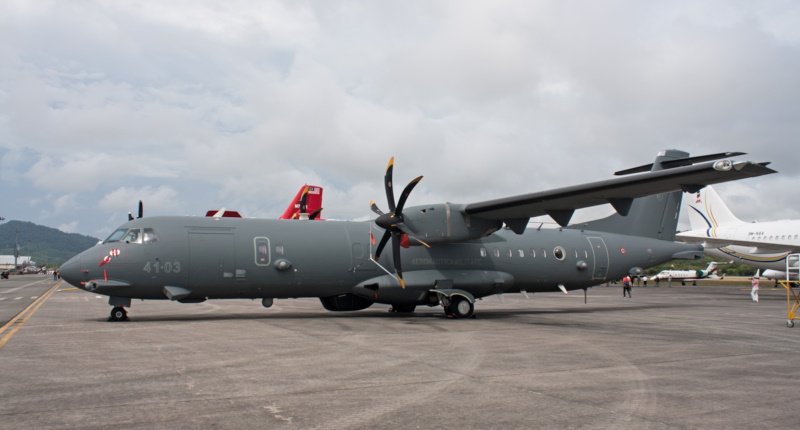
Initial deliveries were in 2012, with the machines operated by mixed air force and navy crews. In 2008, the Italian Air Force also ordered four "ATR 72MP" (for "Maritime Patrol") machines derived from the ATR 72ASW, with introduction to service in 2017 with the service designation of "P-72A". The MP machines have similar kit to the ASW machines, but lack ASW-specific kit like a sonobuoy launcher. The MP machines have a rear door that can be opened in flight to drop rescue kit; it is unclear if the ASW machines had this feature. The Italian Customs Police ordered one ATR 72MP in 2018, following it up with an order for three more in 2019, with deliveries from 2019 to 2022. Malaysia ordered two in 2022.
The ATR series has proven a great success, with over 1,500 aircraft sold to date. ATR is currently defining a next-generation turboprop. The goal for the design is an aircraft with 80 to 100 seats, featuring higher speed of up to about 610 KPH (380 MPH / 330 KT) and 20% lower fuel consumption. In addition, climb rate will be increased, and maintenance costs reduced. An active vibration cancellation system is being considered as a means of providing a smoother ride, both improving passenger comfort and extending airframe life.
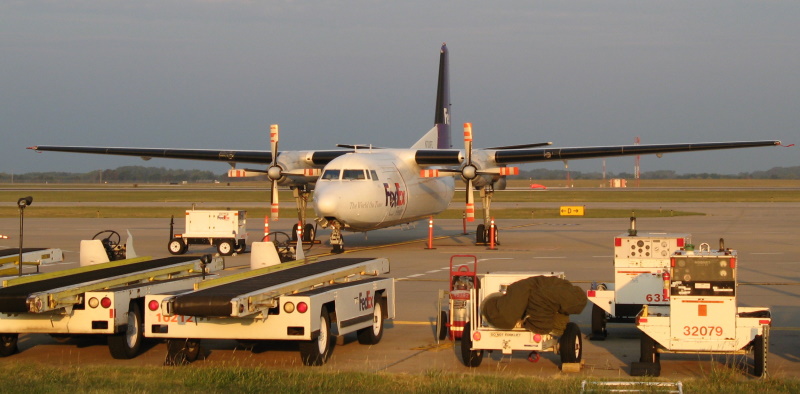
BACK_TO_TOP* I have vague memories of the F-27 from when I was a lad back in the 1960s; I recall it was fairly common -- indeed, I think I flew on one once or twice -- which was unusual for a foreign-designed aircraft in those days, US airlines having a strong inclination to "buy American". Of course, Fairchild production helped entry into the US market. Much more recently, I was a bit surprised to see ATR 42 air freighters of the Federal Express hub in Spokane, Washington. The "buy American" prejudice may still linger, but if so, it is nowhere as strong as it once was.
Incidentally, there's a video of a Dutch military F27 in camouflage colors at an airshow, jinking around in a flight demonstration leaving smoke trails behind it. The F27 couldn't match the agility of a fighter or trainer -- it seems it could not fly inverted, and so the most the pilot could do was stand it on a wing -- but it was impressive to see such a relatively large aircraft thrown around so aggressively. I suspect that unloaded, an F27 had a fairly high power-to-weight ratio.
* Sources include:
Details were obtained from my set of JANE'S ALL THE WORLD'S AIRCRAFT
* Illustrations details:
* Revision history:
   v1.0.0 / 01 jul 12
   v1.0.1 / 01 jun 14 / Review & polish.
   v1.0.2 / 01 may 16 / Review & polish.
   v1.0.3 / 01 apr 18 / Review & polish.
   v1.0.4 / 01 apr 18 / Review & polish.
   v1.1.0 / 01 mar 20 / General update.
   v1.1.1 / 01 jan 22 / Review & polish.
   v1.1.2 / 01 dec 23 / Review, update, & polish.
BACK_TO_TOP
