
* In the 1980s, the Cessna Corporation of the USA began work on a single-engine turboprop utility aircraft, which would emerge as the Cessna 208 "Caravan". It proved extremely popular, with Caravans sold to customers all over the globe. It has been followed by roughly comparable aircraft, including the Quest "Kodiak". This document provides a history and description of the Caravan and Kodiak, as well as the smaller Mahindra (GippsAero) "Airvan".
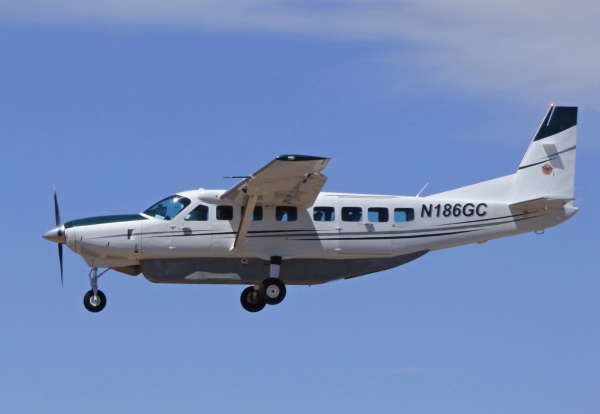
* In 1981, Cessna began work on a next-generation "bushplane", designed for hauling passengers and cargo under austere conditions. The initial idea was to mate a turboprop engine to the Model 206 Skywagon, in popular use as a bushplane, but the result didn't have adequate range; a new design was required. After hiring on two consultants who had been with de Havilland Canada, maker of popular bushplanes like the Beaver, Otter, and Twin Otter, Cessna came up with the "Model 208 Caravan" -- a single-engine turboprop machine with a high wing, fixed tricycle landing gear, a boxy fuselage that could accommodate three-abreast seating, and a large cargo door.
The first Model 208 prototype performed its initial flight on 9 December 1982. The first production Caravan was rolled out in August 1984. It was powered by a single Pratt & Whitney Canada (PWC) PT6A-114 turboprop engine providing 448 kW (600 SHP), and driving a three-bladed reversible Hartzell propeller. Incidentally, Caravan propellers are a small but confusing subject: three-bladed McCauley propellers would also be fitted to the Caravan; as well as four-bladed props from Hartzell, McCauley, and MT-Propeller.
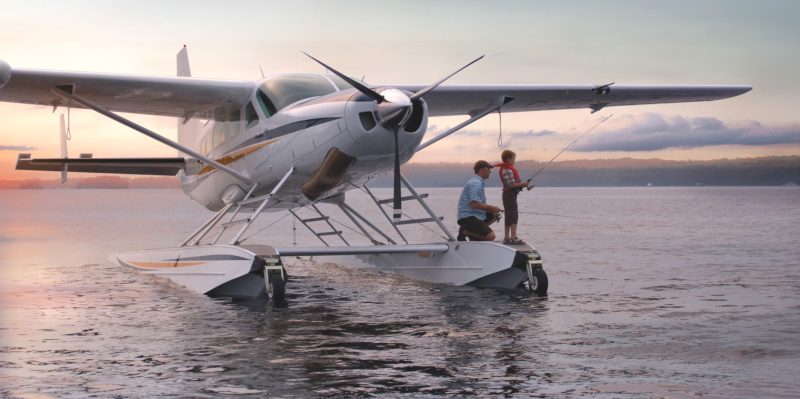
All flight surfaces were straight, with the tail featuring a large leading-edge fillet. The wings featured twin spars, a single bracing strut on each side of the aircraft, and a dihedral of 3 degrees. Flight controls were conventional and mechanically actuated, except for electrically actuated flaps. All landing gear assemblies had single large wheels, with disk brakes on the main wheels; the nosewheel was steerable. An amphibian version was available, featuring floats with optional retractable landing gear -- additional "finlets" were placed on tailplane of the floatplane to ensure yaw stability. Ski landing gear was another option.
The Model 208 featured a basic avionics suite. An optional Bendix/King RDS-82 weather radar could be fitted in a pod on the leading edge of the right wing. De-icing gear was also optional, tropical operators having little need for it, with the de-icing kit including pneumatic de-icing boots for the flight surfaces and electrical de-icing for the windscreen. Up to ten passengers or 1,360 kilograms (3,000 pounds) of freight could be carried. Heating was standard, air conditioning optional; the cabin was unpressurized, with an oxygen system optional. There were cockpit doors on each side; a horizontally-split (open up / down) cargo door on the left rear fuselage; and a fold-down "airstair" door on the right rear fuselage.
   ___________________________________________________________________

   CESSNA MODEL 208 CARAVAN:
   ___________________________________________________________________

   wingspan:
     15.88 meters (52 feet 1 inch)
   wing area:
     25.96 sq_meters (279.4 sq_feet)
   length:
     11.46 meters (37 feet 7 inches)
   height:
     4.32 meters (14 feet 2 inches)

   empty weight:
     1,724 kilograms (3,800 pounds)
   MTO weight:
     3,310 kilograms (7,300 pounds)

   max speed at altitude:
     325 KPH (200 MPH / 175 KT)
   service ceiling:
     8,410 meters (27,600 feet)
   take-off run:
     300 meters (1,000 feet)
   range:
     1,800 kilometers (1,115 MI / 970 NMI)

   ___________________________________________________________________
* Sales of the initial Model 208 were modest at first, until Federal Express entered into discussions with Cessna to build a Caravan variant optimized for the parcel business. The result was the "Model 208A Cargomaster", which was a pure cargolifter, with the passenger windows and left rear door deleted, plus a large cargo pannier fitted to the belly. It also featured an increase in tail height by 15 centimeters (6 inches), longer engine exhausts to keep hot exhaust gases off the pannier, and Bendix-King avionics. FedEx ordered 177 Cargomasters, and the Caravan series took off.
BACK_TO_TOP* The Model 208A proved highly reliable and easy to maintain. FedEx liked the Cargomaster so much that the company then ordered a derivative with higher load capacity, the "Model 208B Super Cargomaster", which featured a 1.22-meter (4-foot) fuselage stretch, obtained by inserting plugs fore and aft of the wing, and a more powerful PT6A-114A turboprop engine with 503 kW (675 SHP). Load was increased to 1,590 kilograms (3,500 pounds). Initial flight of the first Super Cargomaster was on 3 March 1986, with deliveries later in that same year. The Super Cargomaster led in turn to a similarly stretched version of the Caravan, the "Model 208B Grand Caravan", with windows and a quick-change cabin capable of carrying 14 passengers or freight. The pannier was optional.
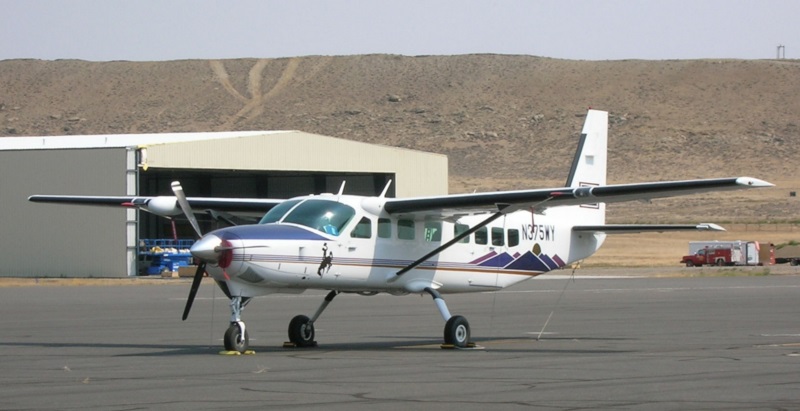
In 1998, the original Model 208A was relaunched with the PT6A-114A engine as the "Caravan 675", with the "675" of course standing for the engine horsepower. The Garmin G1000 glass cockpit was fitted in production from 2008. The latest version, the "Grand Caravan EX", was introduced in 2012; it features a PT6A-140 engine with 647 kW (867 SHP) that provides excellent "hot and high" performance, the aircraft also featuring updated avionics. By the end of 2015, over 2,500 Caravans had been delivered.
There have been a number of third-party conversions of Caravans, usually involving engine upgrades. One of the more prominent is the Texas Turbines "Supervan", with a Honeywell TPE331-12JR with 670 kW (900 HP). Texas Turbines has updated dozens of Caravans, and is now offering a five-blade prop from MT-Propeller of Germany. Other firms offer updates to TPE331 engines, or more powerful PT6A variants.
In the mid-1990s, the Soloy company flew a "Pathfinder 21" upgrade of the Caravan, with a 1.83-meter (72-inch) fuselage stretch for carriage of 15 to 19 passengers, and a "twinpac" engine system with dual PT6D-114A engines, providing 495 kW (665 HP) each, driving a single prop. The prototype flew in 1995, but the program bogged down in certification problems -- the larger passenger capacity meant the aircraft had to meet tougher specifications -- and was abandoned.
The Caravan has also been used as an experimental platform. Propulsion company Magnix, working with engineering firm AeroTEC, flew a pure electric 208B Grand Caravan from 2020, powered by a Magnix's Magni500 electric motor with 560 kW (750 HP), with a lithium-ion battery pack weighing about a tonne (1.1 tons). Also from 2020, a San Francisco Bay Area startup company named XWing flew a fully autonomous Model 208B, under the control of an XWing "Autoflight" system that could be ported to a wide range of existing aircraft. The company planned to use robot aircraft for short-range cargo flights. Reliable Robotics, another startup in the Bay Area, has flown a robot Caravan as well.
* In 1986, Cessna began to promote a militarized version of the Caravan, the "U-27A", intended primarily for troop and cargo transport, paradropping, and medevac missions. It had an increased electrical power supply to support avionics for other missions such as electronic surveillance and maritime patrol. A "Low Intensity Conflict Aircraft" version was also proposed, featuring one centerline and six underwing pylons to carry offensive stores, and there was consideration of its use for counterinsurgency operations in South America.
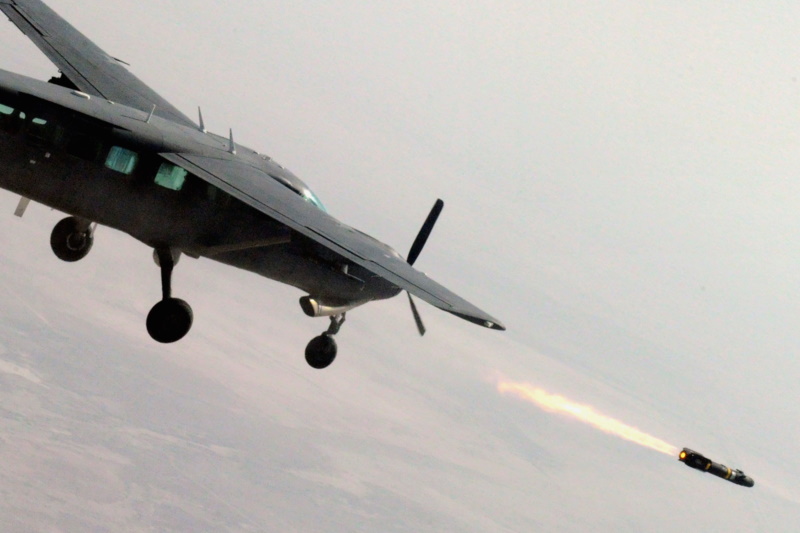
Nothing came of the effort early on, but in 2009 the Iraqi Air Force (IqAF) obtained five armed Cessna Grand Caravan 208Bs for the counter-insurgency role. These "AC-208B Combat Caravans" featured an electro-optic / infrared (EO/IR) turret on the belly and a stores pylon on each wing, the usual store being two Hellfire missiles per pylon. Small laser-guided bombs and 70-millimeter rockets were also plausible stores.
The combat systems were leveraged from the Predator drone. The turret was offset to the left while the engine exhaust was shunted to the right to avoid thermal interference. The Combat Caravans featured armor protection, weather radar, a datalink system, and a defensive countermeasures system. The combat modifications were performed by ATK Integrated Systems in Forth Worth, with Iraqi pilots trained in Texas as well. The IqAF also obtained Caravans for the transport, training, and surveillance roles, with the designations of "C-208B", "TC-208B", and "RC-208B" respectively.
The AC-208B was obtained by Afghanistan and Lebanon as well. Jordan has obtained, or is obtaining, 12 Caravans, including 8 Grand Caravans and 4 Caravan EX machines, all configured for the intelligence / surveillance / reconnaissance role. It doesn't appear that any of them carry munitions, though armament capability could be easily added.
A number of the military forces of African nations have obtained militarized Caravans; some were strictly transport-utility machines, others had surveillance kit, but it doesn't appear any were armed. Caravans also went into service with the US Air Force Special Operations Command (AFSOC) in small numbers; it is unclear if these AFSOC machines were armed. The US Army experimented with an "optionally piloted" Caravan 208B UAV under the "Caravan Optionally Piloted Aircraft (COPA)" project. COPA Caravans would be used for high-risk missions; however, the effort seems to have gone quiet.
BACK_TO_TOP* In the 1990s a kitplane producer named Tom Hamilton teamed up with David Voetmann, a pilot who had spent his career flying for humanitarian nongovernmental organizations (NGOs), notably missionary organizations, to develop a modern bushplane with an eye towards NGO use, as a follow-on to the Cessna 206 Skywagon. The two actually got more than a dozen NGOs to back the exercise, promising to hand out one aircraft to the NGOs for every nine sold commercially.
They set up the Quest firm in Seattle in 2002, the CEO being Bruce Kennedy, who had run Alaska Airlines. Quest had a prototype "Kodiak 100" flying by 2004, with the first production machine flying in 2007 and certification following. As it emerged, the Kodiak was very much along the lines of the Caravan, having a boxy fuselage, a high braced wing, and fixed tricycle landing gear -- floats were available as an option for amphibian operation, the tailplane being fitted with finlets in that case. The Kodiak was powered by a PWC PT6A-34 turboprop engine providing 560 kW (750 SHP) and driving a four-bladed Hartzell reversible propeller.
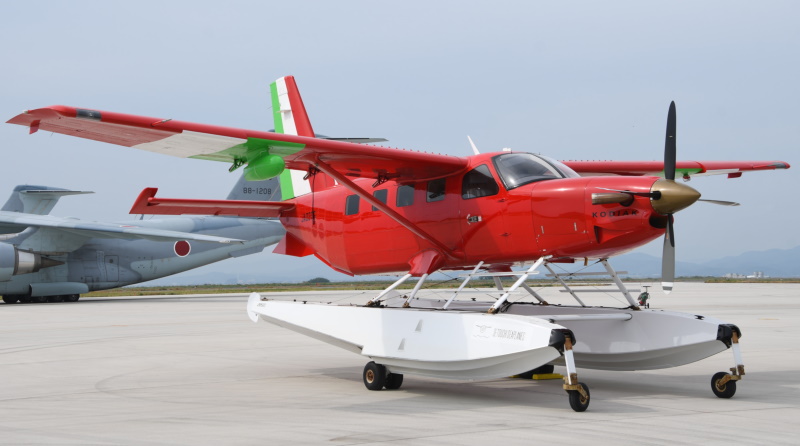
Its empty weight was close to that of a Caravan. It had a cabin with a volume of 7.1 cubic meters (250 cubic feet, a maximum payload of 1,590 kilograms (3,500 pounds), and could take off in fully loaded condition in 300 meters (1,000 feet), though its only high-lift devices were wide-span one-piece slotted flaps. A cargo pannier was optional. There were doors on either side of the cockpit and a horizontally-split cargo door, the lower half featuring integral steps. An alternative roll-up cargo door, for parachuting and paradropping, was on offer as an option. Eight easily-removed passenger seats could be installed -- some sources mention arrangements with 9 or 10 passenger seats as well -- and a VIP club-style "Summit interior" was also available. The Kodiak featured a Garmin 1000 glass cockpit; autopilot, de-icing, and weather radar were optional.
   ___________________________________________________________________

   QUEST KODIAK 100:
   ___________________________________________________________________

   wingspan:
     13.72 meters (45 feet)
   wing area:
     22.3 sq_meters (240.1 sq_feet)
   length:
     10.19 meters (33 feet 5 inches)
   height:
     4.7 meters (15 feet 5 inches)

   empty weight:
     1,710 kilograms (3,770 pounds)
   MTO weight:
     3,290 kilograms (7,255 pounds)

   cruise speed:
     340 KPH (210 MPH / 185 KT)
   service ceiling:
     7,260 meters (25,000 feet)
   take-off run:
     300 meters (1,000 feet)
   range:
     2,060 kilometers (1,280 MI / 1,115 NMI)

   ___________________________________________________________________
Sadly, Kennedy was killed in an air crash in 2007 and the company then ran into financial difficulties, but a group of NGO-friendly investors came to the rescue. In 2015, the company was bought out by Setouchi of Japan, which previously was the Japan distributor for Kodiaks.
A "Series II" Kodiak was introduced in 2018, the primary enhancement being updated avionics, built around a new Garmin glass cockpit. It also featured an improved interior and better soundproofing, with single-point refueling being an option. The company was bought out by Daher in 2019. By that time, over 250 Kodiaks had been sold.
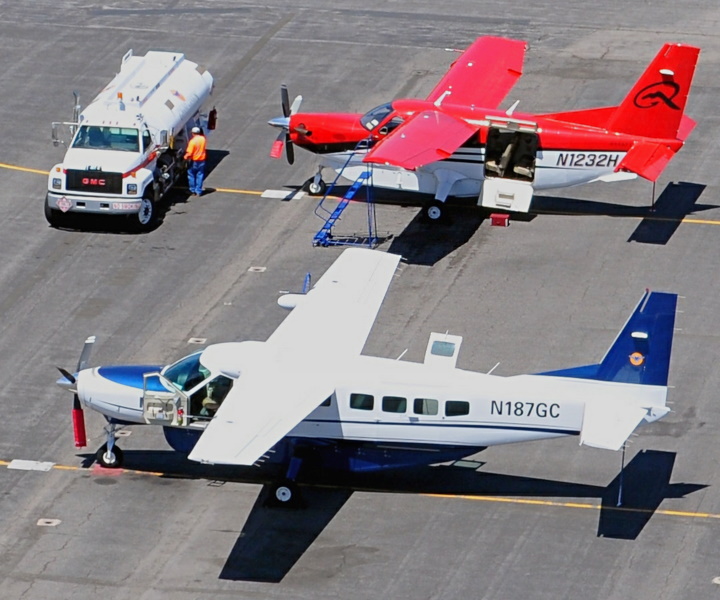
Although Quest is focused on NGOs, the company is also interested in the military, paramilitary, and law enforcement market. The company teamed up with Northrop Grumman to turn a Kodiak into the "Air Claw" demonstrator -- featuring a belly tray with an EO-IR imaging turret and a wide-area imager. The Air Claw system included software for analysis of sensor imagery. From 2021, Angola acquired six Kodiak 100s with an EO-IR pod for surveillance; it is not clear if the Angolan machines owed anything of substance to the Air Claw concept.
BACK_TO_TOP* The GippsAero company of Australia developed a tidy utility aircraft designated the "Airvan 8" -- with a clear resemblance to the Caravan, the Airvan 8 sometimes being referred to as the "Caravan Lite".
GippsAero -- more formally Gippsland Aeronautics, Gippsland being a rural region of Victoria, Australia -- was founded in the 1970s as an aircraft maintenance and modification operation. One thing led to another, with the firm introducing its own new-design agricultural aircraft, the "GA-200", in 1991. GippsAero then went on promptly to develop a utility machine, the "GA-8 Airvan", which performed its initial flight in 1994. It finally obtained certification in 2000. In 2010, Mahindra Aerospace of India acquired a controlling interest in GippsAero -- one suspects partly with Indian sales in mind, the Airvan being a good fit for communications with rural India -- and then gave the type its modern "Airvan 8" name.
The "Caravan Lite" label was accurate to the extent that the Airvan's empty weight was about 55% that of a Caravan. However, the Airvan 8 was obviously not a copy of the Caravan, merely being the same sort of machine on a smaller scale. Like the Caravan, the Airvan 8 had a high braced wing, fixed tricycle landing gear, and a boxy fuselage. However, along with the smaller size, the Airvan 8 differed by featuring more angular and rakish lines, as well as a piston engine instead of a turboprop -- a Lycoming IO-540 flat-six air-cooled engine providing 225 kW (300 HP), driving a three-bladed Hartzell propeller. A "GA-8 TC-320" variant with a turbocharged TIO-540 engine providing 240 kW (320 HP) was also available.
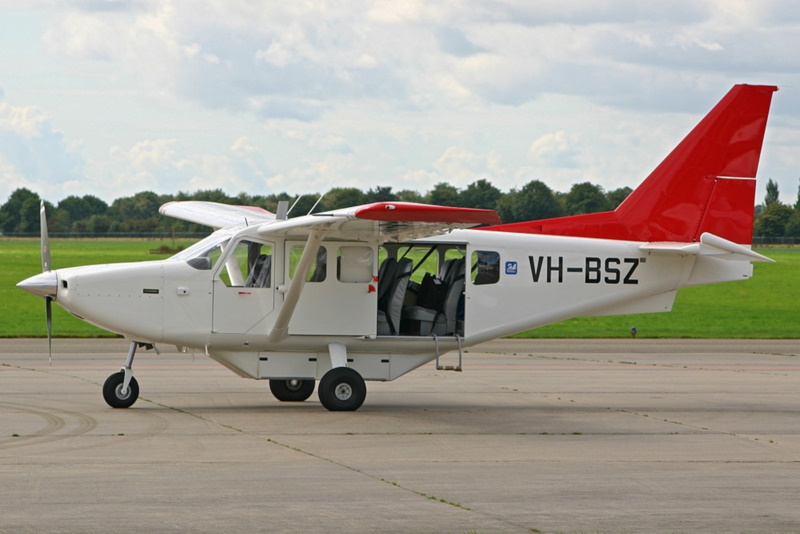
The Airvan 8 had a front-hinged crew door on each side of the cockpit and a forward-sliding rear door for passenger and cargo loading. The door was about 105 centimeters (42 inches) on each side and could be opened in flight, making the aircraft useful for parachuting. It could be fitted with seven passenger seats, not including the pilot seat; the seats snapped in or out with a minimum of effort, leaving a flat cargo floor with tie-down points when removed. It could haul a load of up to 800 kilograms (1,765 pounds).
The Airvan 8's windows provided a good field of view for both pilot and passengers, and the aircraft was designed to be easily maintained, with plenty of access panels. The standard dashboard layout was mostly traditional analog, but "glass cockpit" configurations were available on customer request. A belly pannier was available as an option, this addition enhancing the Airvan 8's resemblance to the Caravan. Floats were also qualified.
   ___________________________________________________________________

   MAHINDRA AIRVAN 8:
   ___________________________________________________________________

   wingspan:
     12.41 meters (40 feet 8 inches)
   wing area:
     19.32 sq_meters (208 sq_feet)
   length:
     8.95 meters (29 feet 3 inches)
   height:
     3.89 meters (12 feet 10 inches)

   empty weight:
     1,000 kilograms (2,200 pounds)
   MTO weight:
     1,815 kilograms (4,000 pounds)

   top cruise speed:
     240 KPH (150 MPH / 130 KT)
   service ceiling:
     6,100 meters (20,000 feet)
   take-off run:
     450 meters (1,500 feet)
   range:
     1,350 kilometers (840 MI / 730 NMI)

   ___________________________________________________________________
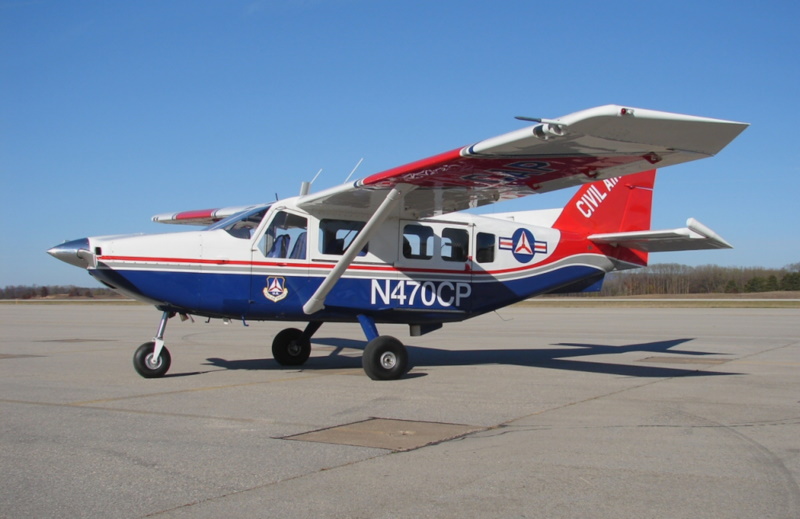
By 2018, roughly 240 Airvan 8s had been sold, with the type being operated all over the world. One of most high-profile sales was of 16 Airvan 8s to the US Civil Air Patrol (CAP), a US Air Force auxiliary that gives young people flight experience and also performs search and rescue (SAR) duties. These Airvan 8s featured a Garmin 1000 glass cockpit and a scanner system named ARCHER for SAR duties.
This prestigious sale helped promote the Airvan 8 as the "Airvan Astra" for SAR and surveillance in service to law enforcement and paramilitary security organizations, as well as military forces on a budget. The Airvan Astra featured a belly fairing similar to the standard cargo pannier for mounting electro-optical imaging turrets and other gear, with workstations installed in the passenger section of the aircraft.
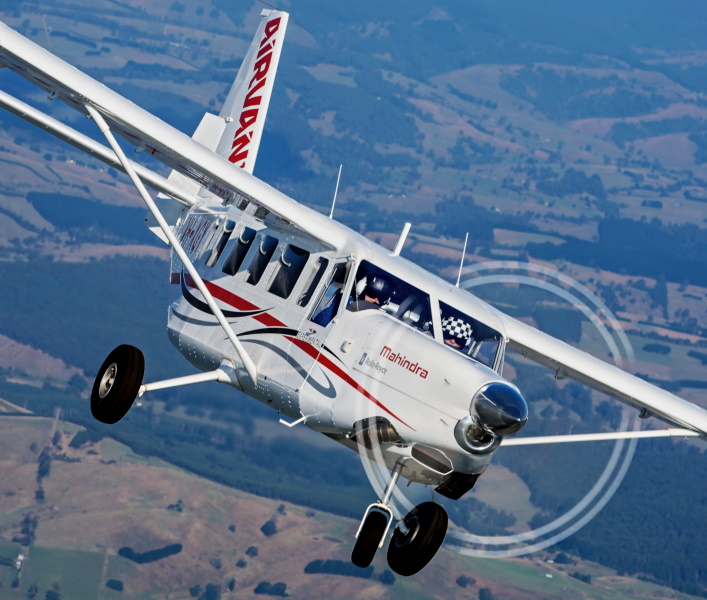
Mahindra went on to introduce a turboprop-powered version of the Airvan 8, the "Airvan 10" -- originally "GA-10" -- stretched by 14% to 10.23 meters (33 feet 7 inches) and having a total of ten seats, initial flight of the prototype being in 2012. It looked even more like a Caravan, but the Airvan 10 was still not in that league, with an empty weight about 60% that of a Caravan. It was powered by a Rolls-Royce Allison 250-B17F/2 turboprop engine, with a take-off power of 335 kW (450 SHP). Certification was in 2017 -- but the Airvan didn't go any farther. Sales of almost all civil aircraft plummeted during the great COVID-19 pandemic of 2020, with Airvan sales zeroing out. Mahindra then terminated all Airvan production. There's been talk of putting the Airvan line up for sale, but nothing's happened so far.
BACK_TO_TOP* Incidentally, Cessna also produced a "Model 406 Caravan II" in cooperation with Reims of France, but other than the name it has little to do with the Model 208 Caravan, being a twin-turboprop machine derived from earlier Cessna twins. The Caravan name seems to have been carried over strictly for marketing purposes, the two aircraft having nothing substantial in common. It went out of production when Reims was liquidated in 2014.
* Sources include:
A number of editions of JANE'S ALL THE WORLD'S AIRCRAFT, plus the Cessna and GippsAero websites, were also consulted.
* Illustration credits:
* Revision history:
   v1.0.0 / 01 may 09 / Originally teamed with Pilatus PC-21.
   v1.0.1 / 01 mar 11 / Review & polish.
   v1.0.2 / 01 aug 11 / Review & polish.
   v2.0.0 / 01 may 12 / Added GippsAero GA-8.
   v3.0.0 / 01 apr 13 / Split out PC-21, added Quest Kodiak.
   v3.0.1 / 01 mar 15 / Review & polish.
   v3.0.2 / 01 feb 17 / Review & polish.
   v3.0.3 / 01 jan 19 / Review & polish.
   v3.1.0 / 01 dec 20 / Illustrations update.
   v3.1.1 / 01 oct 22 / Review & polish.
   v3.1.2 / 01 aug 24 / Review & polish. (+)
BACK_TO_TOP
