
* During World War I, German aircraft designer Dr. Claude Dornier led a division of the Zeppelin company that pioneered development of flying boats. In 1922, Dornier assembled components of the old Zeppelin concern into the new company Dornier Metallbau GMBH, the firm becoming well-known for its flying boat designs, as well as for the Do 17 and Do 217 twin-engine bombers used during World War II. In the postwar period, the Dornier firm developed a piston-engine utility aircraft, the "Do 27", which would evolve through a series of forms -- the "Do 28", the "Do 128", and the "Do 228" -- to result in the "Do 328" and "Do 328JET" airliners. This document provides a history and description of Dornier's postwar civil aircraft. A list of illustration credits is included at the end.
* After the end of World War II, the Allied occupying powers were not keen on the idea of a restored German arms industry and placed limits on what could be built in Germany, one limit being a ban on military aircraft. Claude Dornier was no stranger to such circumstances, having had considerable experience in working around similar bans after World War I, and accordingly set up an "Oficinas Tecnicas Dornier" in Spain in 1949, the office working closely with the Spanish CASA aviation firm.
The first major project taken on by the Dornier office in Spain was a single-engine short take-off / landing (STOL) utility aircraft for the Spanish Air Ministry, the Dornier "Do 25", the first of two prototypes performing its initial flight at Seville on 25 June 1954 with CASA test pilot Ernesto Nienhuisen at the controls. The Do 25, also known by its Spanish military designation of "XL-9", had a configuration generally along the lines of the classic Fieseler Storch STOL utility aircraft, being a high-wing tailwheel monoplane -- though it differed from the Storch in deleting wing bracing and being larger, with seating for four. The first prototype was powered by the Spanish Elizalde / ENMA Tigre G-1V-B four-cylinder air-cooled inverted inline engine with 112 kW (150 HP). The second prototype was originally flown with the same engine, but in the spring of 1955, it was refitted with a US-built Continental O-470-J flat-six air-cooled engine with 170 kW (225 HP).
With the Cold War coming into its own in the early 1950s, a degree of German re-armament seemed like a good idea after all, and so restrictions on German military production were relaxed. In mid-1955 Dornier was able to re-open its production facilities in Germany, with the Do 25 prototype design being enhanced for a production derivative, the Dornier "Do 27", with the prototype performing its initial flight, in Spain, on 17 June 1955, followed by two more developmental machines. The first flight of a production machine, in Germany, was on 17 October 1956.
   ___________________________________________________________________

   DORNIER DO 27A-4:
   ___________________________________________________________________

   wingspan:
     12 meters (39 feet 4 inches)
   wing area:
     19.4 sq_meters (208.8 sq_feet)
   length:
     9.6 meters (31 feet 6 inches)
   height:
     2.8 meters (9 feet 2 inches)

   empty weight:
     1,130 kilograms (2,490 pounds)
   max operating weight:
     1,850 kilograms (4,080 pounds)

   max speed at altitude:
     225 KPH (140 MPH / 120 KT)
   service ceiling:
     3,300 meters (10,825 feet)
   range:
     1,100 kilometers (685 MI / 595 NMI)

   ___________________________________________________________________
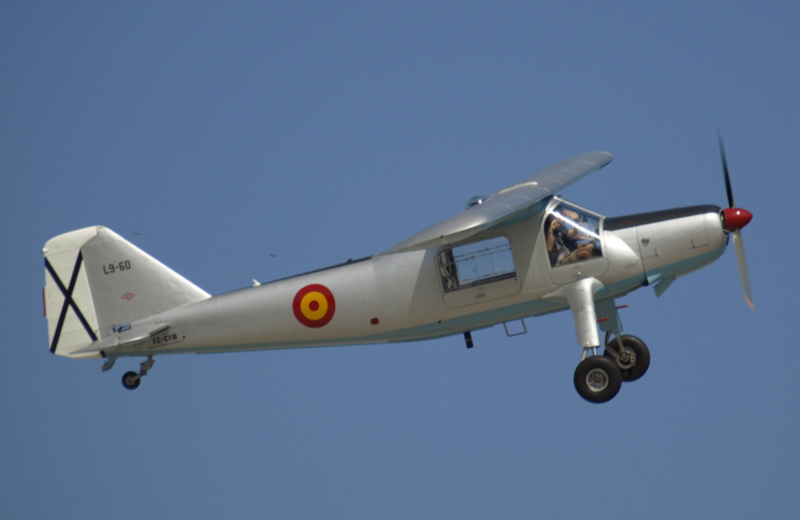
The baseline initial production "Do 27A" was configurationally much like the Do 25 but more capable, with a Lycoming GO-480-B1A6 flat-six air-cooled engine providing 200 kW (270 HP) and driving a two-bladed prop. Large double slotted flaps gave excellent STOL performance; the wraparound windscreen provided a wide field of view; the aircraft had comfortable accommodations for up to six crew and passengers, and could be used to haul cargo as well. It was built in four subvariants:
A "Do 27B" series was built, generally identical to the Do 27A series except for dual controls, with subvariants including:
The West German Army -- the Heer -- and Air Force -- the Luftwaffe -- ordered a total of 428 Do 27As and Do 27Bs. 50 Do 27A-1 machines were built in Spain by CASA as the "C-127" for the Spanish military.
16 examples of the "Do 27H" variant were built for the Swiss Air Force, similar to the Do 27A but with a supercharged Lycoming GSO-480-B1B6 engine providing 250 kW (340 HP), a three-bladed instead of two-bladed propeller, and larger tail unit. The Swiss obtained one "Do 27H-1" and fifteen slightly enhanced "Do 27H-2" machines.
The Belgian Army obtained 12 "Do 27J-1" machines, which were minor variations of the Do 27A-4; while the Portuguese Air Force obtained 16 "Do 27K-1" and 24 "Do 27K-2" machines, again minor variations on the Do 27A-4.
Dornier also built a specific "Do 27Q" series for civil users, which was similar to the Do 27A series; it was easily reconfigured for training, air ambulance, glider tug, and aerial survey roles. Subvariants included:
A turboprop variant, the "Do 27T" with a Turbomeca Astazou II engine, was built as well, but did not reach production; and at least one Do 27 was fitted with floats by a third party company as the "Do 27S-1".
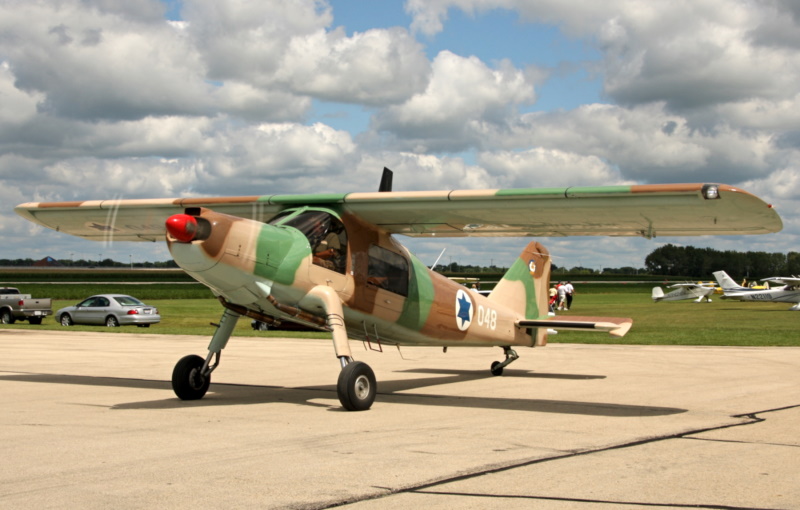
A total of 626 Do 27s in all variants was built up to end of production in 1966. When the Luftwaffe retired their Do 27s, Portugal acquired about 76 of them. Other users of new or, for the most part, used Do 27s included Belize, Burundi, the Congo, Guinea-Bissau, Israel, Mozambique, Nigeria, South Africa, Rwanda, Sudan, Sweden, and Turkey.
BACK_TO_TOP* The Do 27 proving a clear success, Dornier company officials decided that a twin-engined version would be a good idea, leading to flight of the prototype of the "Do 28A" on 29 April 1959. It was a fairly direct derivative of the Do 27, though the adaptation of the Do 27 to a twin-engine configuration was unconventional: while much of the Do 27 airframe remained more or less intact, the cockpit was expanded, the nose was faired over, and a stub pylon was fitted to each side of the nose to mount a nacelle for a piston engine. A new fixed main landing gear unit with spats was attached to the bottom of each engine nacelle.
The initial prototype was powered by twin Lycoming O-380-A1A flat-four air-cooled piston engines providing 135 kW (180 HP) each, driving fixed-pitch two-blade propellers. Trials showed the prototype left something to be desired, and so the initial production variant, the "Do 28A-1", featured improvements such as a longer-span wing and more powerful engines -- in the form of Textron Lycoming O-540 flat-six air-cooled engines with 185 kW (240 HP) each. The aircraft could carry up to eight aircrew and passengers, or two litters and an attendant, or (with seats removed) a freight load. 60 were built, with sales targeted at the executive transport market. At least one was converted to a floatplane configuration.
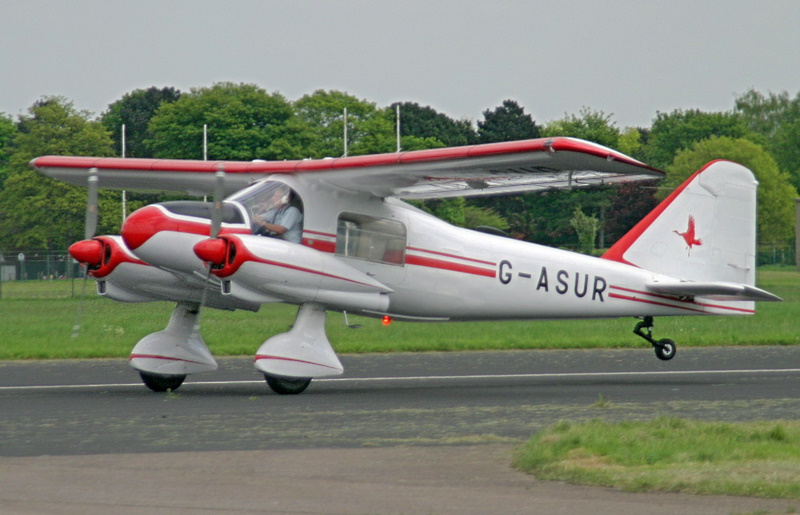
The Do 28A-1 was followed in 1963 by the "Do 28B-1", which had more powerful IO-540-A engines with fuel injection, providing 215 kW (280 HP) each, plus a larger nose; more fuel tankage; a larger tailplane; three-bladed variable-pitch constant-speed propellers; and electrically-actuated flaps. Total production also was 60, with that number including at least one "Do 28B-2" machine featuring TIO-540 engines with turbocharging.
   ___________________________________________________________________

   DORNIER DO 28B-1:
   ___________________________________________________________________

   wing area:
     22.4 sq_meters (241.1 sq_feet)
   length:
     9.0 meters (29 feet 6 inches)
   height:
     2.8 meters (9 feet 2 inches)

   empty weight:
     1,800 kilograms (3,970 pounds)
   max operating weight:
     2,720 kilograms (5,995 pounds)

   max speed at altitude:
     290 KPH (185 MPH / 160 KT)
   service ceiling:
     5,900 meters (19,335 feet)
   range:
     1,235 kilometers (765 MI / 980 NMI)

   ___________________________________________________________________
While most sales were on the civil market, the Spanish Air Force used the Do 28 in the utility role, with small numbers similarly flown by Turkey and Israel. They were also used in African "bush wars" in Nigeria and Katanga. One particular interesting user was "Air America", on the face of it an American commercial air transport operation that in reality worked on behalf of the US Central Intelligence Agency (CIA) during the Vietnam War. Air America operated a handful of Do 28A machines for flights into the backwoods of Laos, since it could operate off of very short dirt airstrips, thanks to the Do 28A's excellent STOL capability.
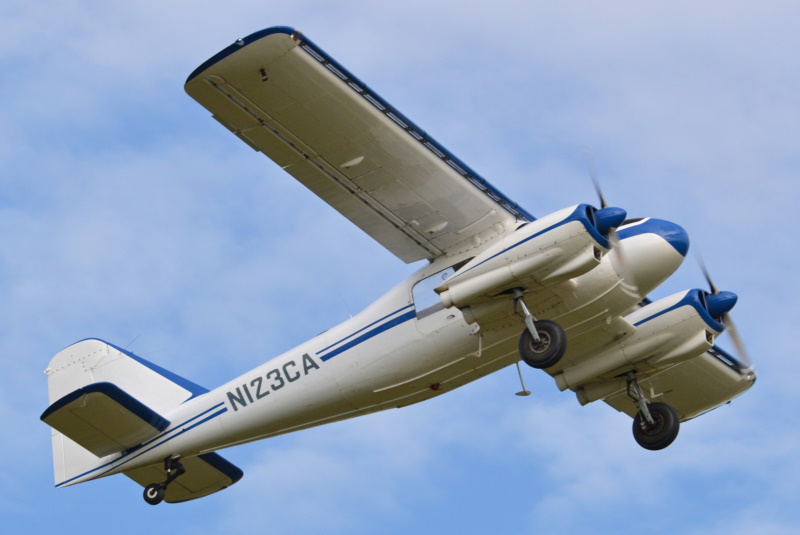
It is not clear exactly what the virtues and defects of the Do 28's unusual engine layout were; it seems it was adopted because it required the least change to the original Do 27 airframe. It provided a wider main gear stance and no doubt the low-mounted engines simplified servicing, but it didn't prove a popular configuration with other manufacturers.
BACK_TO_TOP* Obviously Dornier officials did think the Do 28A/B was a good thing, since in the mid-1960s they initiated work on a scaled-up follow-on with the same overall configuration, leading to first flight of the "Do 28D" on 23 February 1966. The type obtained certification the next year, 1967; only six production Do 28Ds were built, with production quickly moving on to the "Do 28D-1", with wingspan stretched by 50 centimeters (19 inches) and an increased MOW. 54 were obtained by the Luftwaffe, including four configured as VIP transports, with the type given the name "Skyservant".
Re-use of the "Do 28" designation with the Do 28D series was misleading -- apparently deliberately so, amounting to a "name game" to trick government authorities into providing assistance on the basis that the Do 28D wasn't a new aircraft design. Although the Do 28D did have the same general arrangement as the Do 28A/B, with the stub-mounted twin engines and spatted main gear on the bottom of the engine nacelles, it was not only bigger but substantially redesigned, to the point where there was little commonality between the two types of machines. The Do 28D had a boxy "flying delivery truck" fuselage with double doors on the left, as well as a crew door with window on each side of the cockpit. Wing and tailplane form-factor was similar to that of the Do 27A/B, but the tailfin was enlarged and featured a prominent fin fillet.
The Do 27D-1 was powered by twin Avco Lycoming IGSO-540 flat-six air-cooled engines with supercharger and fuel injection, providing 285 kW (380 HP) each and driving Hartzell three-bladed variable-pitch constant-speed props. There were two seats up front, for a pilot and for a copilot or passenger; dual controls were optional. 12 seats could be fitted in the cabin; or 13 tip-up seats; or five tip-up seats along with fittings for five stretchers. There was a toilet and baggage compartment in the rear; there was also baggage space in the nose. Passenger accommodations could be removed for hauling freight.
   ___________________________________________________________________

   DORNIER DO 28D-1:
   ___________________________________________________________________

   wingspan:
     15.5 meters (50 feet 10 inches)
   wing area:
     28.6 sq_meters (307.9 sq_feet)
   length:
     12.0 meters (39 feet 4 inches)
   height:
     3.9 meters (12 feet 10 inches)

   empty weight:
     2,165 kilograms (4,775 pounds)
   max operating weight:
     3,650 kilograms (8,047 pounds)

   max speed at altitude:
     320 KPH (200 MPH / 175 KT)
   service ceiling:
     7,400 meters (24,280 feet)
   range:
     1,810 kilometers (1,125 MI / 665 NMI)

   ___________________________________________________________________
The Do 28D-1 was followed in turn by the "Do 28D-2", with an internal redesign to increase internal cabin length by 15 centimeters (6 inches), more fuel load, and higher MOW. The wing was also modified, with wing fences featured on the Do 28D-1 deleted and other changes. The Luftwaffe ordered 101, with the Bundesmarine -- West German Navy -- obtaining 20 more. Some of the naval machines had an external tank under each wing; it is unclear if this was a capability shared with other Do 28D production, or if other Do 28D users obtained this option.
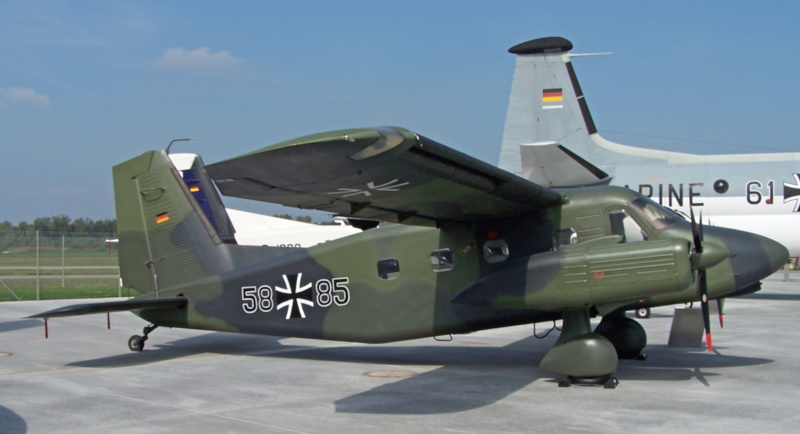
About 50 more Do 28D-2s were built and sold in small numbers to a range of other users, including Cameroon, Ethiopia, Israel, Kenya, Malawi, Morocco, Nigeria, Somalia, Thailand, Turkey, and Zambia. The Turks operated several in the signals intelligence (SIGINT) role, these aircraft being fitted with a belly antenna fairing; Turkey eventually acquired several more Do 28D hand-me-downs when the Luftwaffe began to phase the type out, with Greece also obtaining a number of used machines.
One Luftwaffe Skyservant was refitted with turbocharged TIGO-540 engines in 1980, mostly as a noise-reduction measure, and redesignated "Do 28D-2T". In the mid-1980s, two Bundesmarine Do 28D02s were modified for the pollution patrol role by being fitted with side-looking airborne radar (SLAR), an infrared scanner, and film cameras, with these conversions designated "Do 28D-2OU". In 1980, Dornier production moved on to "Model 128-2" -- which, despite the confusing name change, was merely a minor enhancement of the Do 28D-2. Only a handful were built, with users including Benin and Nigeria.
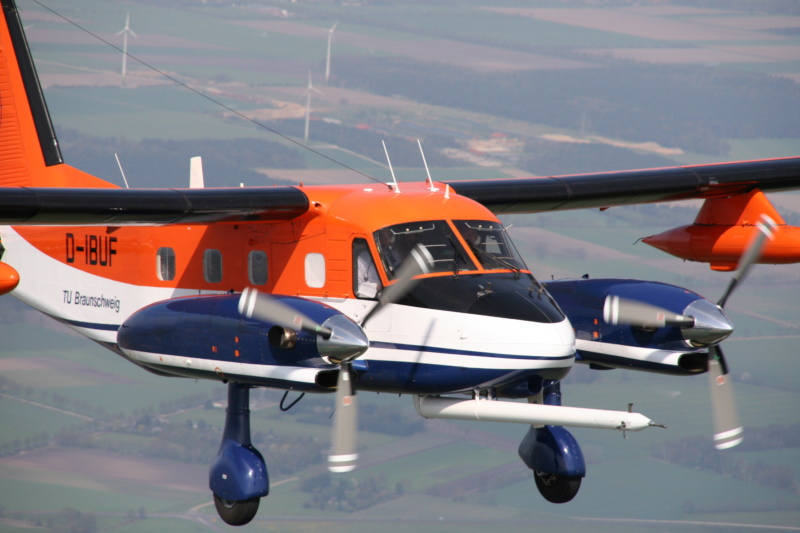
* Dornier began tinkering with turboprop propulsion for the Do 28D in 1978, flying a machine in that year refitted with Avco Lycoming LTP101-600 engines providing 300 kW (400 SHP) each, redesignating it the "Do 28D-5X". In 1980, the same machine was flown with Pratt & Whitney Canada (PWC) PT6A-110 turboprops with the identical power ratings, being redesignated the "Do 28D-6X". That configuration was put into production as the "Model 128-6 Turbo-Skyservant" or "Turbo-Sky", though only a few dozen were built -- including 16 for Nigeria and three for the Cameroons, with the Cameroons machines fitted with radar in an undernose fairing for maritime patrol.
BACK_TO_TOP* While Dornier was working on the Turbo-Skyservant, the company was also considering a more drastic derivative of the Do 28D, involving a new wing conventionally mounting twin turboprops and a stretched fuselage with retractable tricycle landing gear. A formal go-ahead for the development of the "Dornier 228-100" and the similar but stretched "Dornier 228-200" -- originally the "Do 28E-1" and "Do 28E-2" respectively -- was granted in late 1979. Initial flight of the Dornier 228-100 prototype was on 28 March 1981, with initial flight of the Dornier 228-200 prototype following on 9 May 1981. The type received initial certification in late 1981 and initial customer deliveries were performed early in 1982.
Along with being stretched, the redesigned fuselage of the Do 228 differed from the Skyservant primarily in being given a new longer nose arrangement, plus backward-retracting twin-wheel nose gear and single-wheel main gear retracting straight inward into fuselage fairings. The Do 228-100 could carry 15 passengers, while the Do 228-200 could carry 19. The big double doors on the left were retained, but there was a baggage compartment to the rear and in the nose, both with external doors on the left. The long nose gave the Do 228 a slightly awkward appearance; an optional weather radar could be fitted in its front.
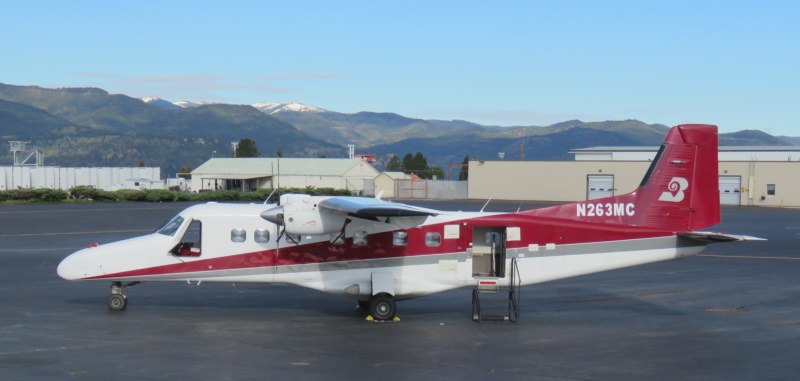
The major innovation was the wing-engine scheme, with the Do 228 featuring a "Tragfluegels Neuer Technologie (TNT / New Technology Wing)" featuring a "supercritical" wing section, and bladelike planform with raked tips. It was demonstrated on a Do 28D-2, flown in 1979. Each wing mounted a Garrett TPE331-5 turboprop engine driving a four-blade Hartzell fully reversible propeller. The initial production variants led to improved versions:
   ___________________________________________________________________

   DORNIER DO 228-212:
   ___________________________________________________________________

   wingspan:
     16.97 meters (55 feet 8 inches)
   wing area:
     32 sq_meters (344.3 sq_feet)
   length:
     16.56 meters (54 feet 4 inches)
   height:
     4.86 meters (16 feet)

   empty weight:
     3,740 kilograms (8,245 pounds)
   max operating weight:
     6,400 kilograms (14,110 pounds)

   max cruise speed:
     415 KPH (255 MPH / 225 KT)
   service ceiling:
     8,535 meters (28,000 feet)
   range, normal payload:
     1,040 kilometers (645 MI / 560 NMI)

   ___________________________________________________________________
Dornier offered the Do 228 in airliner, dedicated cargolifter, troop transport, paratroop transport, air ambulance, aerial survey, military maritime patrol, fisheries patrol, and marine pollution surveillance configurations. There were discussions on license construction of the Do 228 series by the Harbin organization in China, but they came to nothing. However, a license-construction deal was established with Hindustan Aeronautics LTD (HAL) in India, with the first HAL-built machines rolled out in 1986.
India became a prominent military user of the Do 228, the type being used by the Indian Air Force, Coast Guard, and Navy. Coast Guard and Navy machines were fitted out for ocean patrol with a TV/infrared imaging turret, a searchlight, and a camera system. It appears that many of these patrol machines were later fitted with Israeli Elta EL/M-2022A(V3) maritime search radar in a belly fairing, complementing the weather radar in the nose; and at least some had electronic support measures (ESM / emitter location) gear. A new batch of a dozen maritime patrol Do 228s were ordered by the Indian Navy in 2014, with an upgrade program begun in 2024. India has also used the Do 228 as a trials platform, testing radar and other avionics systems.
India donated two maritime-patrol Do 228 machines to the Seychelles, one in 2013 and one in 2018. The Thai Navy obtained seven Do 228s in a comparable maritime patrol configuration; the Thais are now working with RUAG to overhaul and modernize them, with the updated aircraft to feature a new glass cockpit and mission systems.
Finland's border guards obtained two Do 228s with sensor fit for border patrol, while the Dutch Coast Guard similarly obtained two for patrol -- the Dutch retiring them in 2021 -- and sources mentioning the Italian Army obtaining two as well. There were several other military / paramilitary users, including Malawi, Niger, Nigeria, and the Omani police, though it appears these machines were generally in transport configurations.
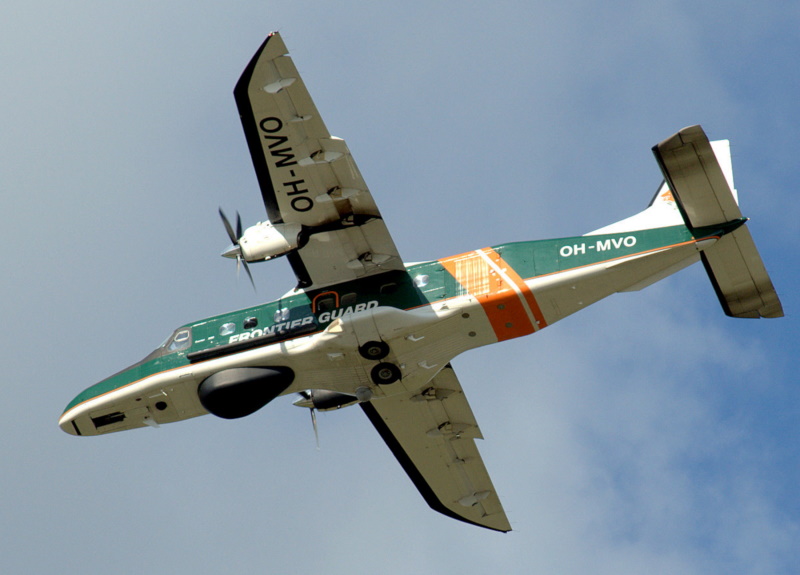
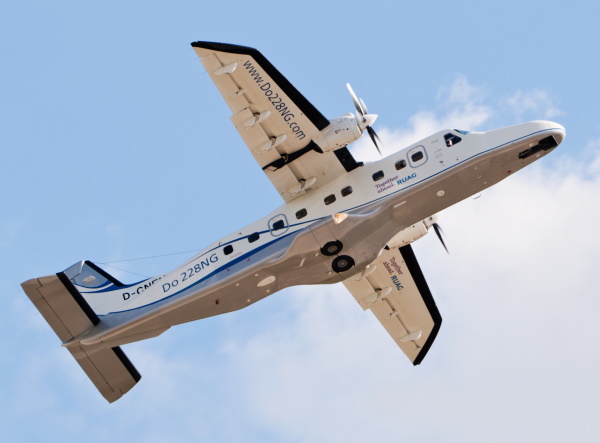
Do 228 production ended in 1998, with about 270 machines built in Germany and India. However, RUAG Aerospace of Switzerland is now turning out "new generation" Do 228s from its facility in Oberpfaffenhofen, Germany. The "Do 228NG" is built in collaboration with HAL, which provides the basic airframe, while RUAG integrates the final product. The Do 228NG features a new glass cockpit, modified interior, and five-bladed props, along with a number of other design tweaks. A new engine was considered but not pursued, at least for the moment, in order to reduce production startup costs.
Initial flight of the first Do 228NG was in November 2009, with initial deliveries in 2010. Along with commercial operators, customers have included the German government, which bought one for oceanic pollution monitoring, and Bangladesh, which obtained two for coastal patrol in 2011, followed by two more in 2017. RUAG sees a market for up to 100 machines.
ZeroAvia, a US startup, has obtained two Do 228s and converted them to hydrogen power. These machines have 600 kW electric motors, fuel tanks with a capacity of 100 kilograms (220 pounds) of hydrogen, and a fuel cell system to convert the hydrogen into electricity. First flight was in early 2023; at the outset, one of the turboprop engines was retained. It isn't clear if the company regards them as operational machines, with ZeroAvia working towards a new-design hydrogen-electric small airliner. The DLR, the German government aerospace research office, is similarly working on updating a Do 228 to hydrogen-electric configuration.
BACK_TO_TOP* In 1986, Dornier considered development of a 30-passenger turboprop regional airliner based on the Do 228, to be designated the "Dornier 328". There was no commitment to the project for two years, but work finally went forward in the summer of 1988, with the initial prototype performing its first flight on 6 December 1991. Two more development machines were built, leading to initial flight of the first production machine in early 1993, with certification and initial customer deliveries in that same year.
The only major inheritance the Do 328 obtained from the Do 228 was the TNT wing. The Do 328 was otherwise a new and more elegant design, with a tee tail and circular cross-section fuselage, constructed of aircraft aluminum alloy along with considerable use of composite materials. The Do 328 was powered by twin PWC PW119B turboprop engines providing 1,625 kW (2,180 SHP) each and driving Hartzell six-bladed reversible composite propellers. An optional auxiliary power unit (APU) could be fitted in the tail.
Each wing featured a two-section Fowler flap and a row of three spoilers on top of the wing. There were twin ventral fins under the tail to deal with yaw instability. Landing gear arrangement was similar to that of the Do 228, with backwards-retracting nose gear and main gear tucking into fairings alongside the fuselage; all gear assemblies had two wheels. Up to 33 passengers could be carried, seated three across; access was through a drop-down "airstair" door on the left front, with emergency exits on both sides. There was a galley; toilet; and a baggage compartment with door on the left in the rear. The Do 328 featured a "glass cockpit" with a Honeywell Primus Epic electronic flight instrumentation system (EFIS).
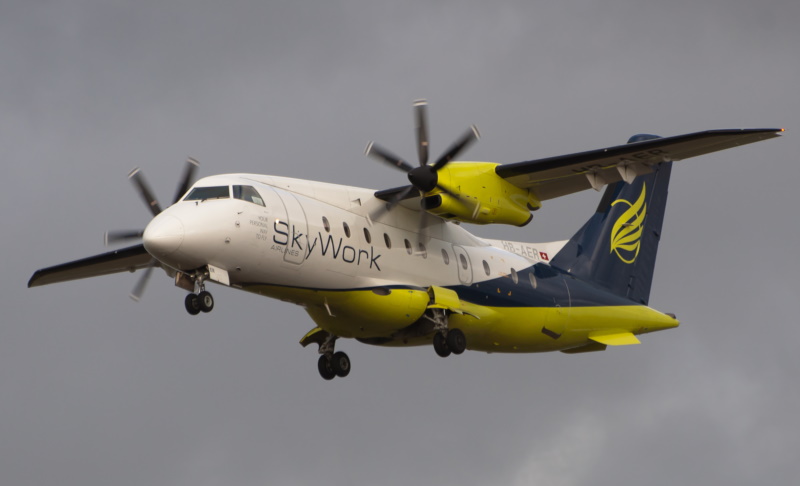
The initial production variant, the "Do 328-100", was followed by the modestly improved "Do 328-110" variant, with increased operating weight, as well as a larger tailfin fillet and modified ventral fins. The Do 328-110 was followed in turn by the "Do 328-120", with improved PW119C engines, larger props, plus larger tailfin fillet and ventral fins. The last production variant was the "Do 328-130", a minor update of the Do 328-120 with features such as enhanced flap settings. Concepts were generated for other derivative variants of the Do 328, but the company decided to move on to turbofan propulsion, as discussed below, with the last of about 105 Do 328 airliners delivered in 2000.
   ___________________________________________________________________

   DORNIER DO 328-110:
   ___________________________________________________________________

   wingspan:
     20.98 meters (68 feet 10 inches)
   wing area:
     40 sq_meters (430.6 sq_feet)
   length:
     21.28 meters (69 feet 10 inches)
   height:
     7.24 meters (23 feet 9 inches)

   empty weight:
     8,920 kilograms (19,665 pounds)
   max operating weight:
     13,990 kilograms (30,842 pounds)

   max cruise speed:
     620 KPH (385 MPH / 335 KT)
   service ceiling:
     7,620 meters (25,000 feet)
   range, max payload:
     1,665 kilometers (1,035 MI / 900 NMI)

   ___________________________________________________________________
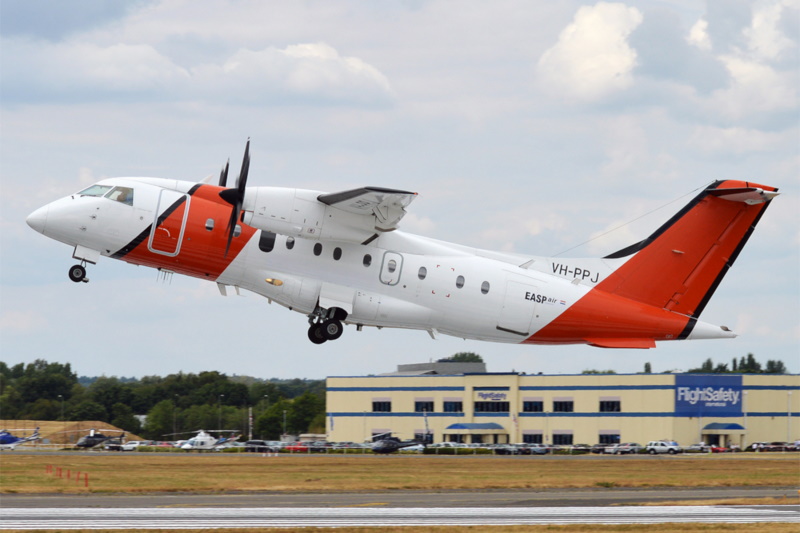
* While the Do 328 was almost always flown as a civil passenger liner, in 2005 the Australian Maritime Safety Authority -- an organization with some similarities to a coast guard, but solely concerned with supervision of shipping -- initiated a program to convert five Do 328-120s to a maritime search and rescue (SAR) configuration, with the converted machines delivered in 2006 and 2007. They featured a turreted infrared imager, an ultraviolet-infrared scanner for pollution monitoring, a radio direction finding system for homing in on rescue beacons, and a radio ship identification system interrogator. Small stores could be dropped through a chute in an emergency exit. All were to be later upgraded with an Israeli ELTA EL/M 2022A search radar, as well as a cargo door that could be opened in flight to drop life rafts and other emergency kit.
The Do 328 is also continuing to provide good service to the US Air Force Special Operations Command (AFSOC), with 16 originally obtained from various operators from 2011. They were refurbished by Sierra Nevada Corporation, being given a gravel protection kit for operations from rough fields, as well as military communications and other avionics systems, possibly including defensive countermeasures. They are designated "C-146A" and are affectionately known by the name "Wolfhound". Some have been photographed carrying specialized surveillance gear, but it appears others are used in the transport role for forward operational support, replacing the smaller M-128 Skytruck in that mission. Photos of the AFSOC Do 328s show them in civilian-style livery. AFSOC apparently has about 20 Wolfhounds; it's hard to know exactly how many, since AFSOC necessarily tends toward the secretive.
In 2019, Sierra Nevada set up a German subsidiary, Deutsche Regional Aircraft GMBH, now just Deutsche Aircraft, to produce the type. DRA is working on an enhanced derivative, the "Do 328eco", which will feature:
First flight of a prototype is expected in 2024, with intro to service in 2025. Development was delayed by the COVID-19 pandemic of 2020:2021. It seems plausible that Sierra Nevada, which is defense-oriented, has the military market partly in mind.
BACK_TO_TOP* Even as the Do 328 was rolling off the production line, Dornier officials felt that the company needed to produce a turbofan airliner to meet customer demand for better performance than that of a turboprop airliner. There was the question of development costs. Daimler-Benz, then a majority stockholder in Dornier, felt that additional resources would be required for the job, and so arranged a merger between Dornier and Fairchild of the USA, with Dornier becoming the "Fairchild-Dornier Germany" subsidiary of Fairchild.
Formal development of the jetliner, designated the "Do 328JET", began in 1996. As the name suggested, the Do 328JET was a relatively straightforward re-engining of the Do 328 with turbofan propulsion, with the second prototype Do 328 re-engined with PWC PW306/9 turbofans with 26.9 kN (2,745 kgp / 6,050 lbf) thrust each and performing its initial flight in that configuration on 20 January 1998. It was followed by a new-build Do 328JET that performed its first flight in May 1998. Four machines were used in trials, leading to certification and first deliveries in 1999.
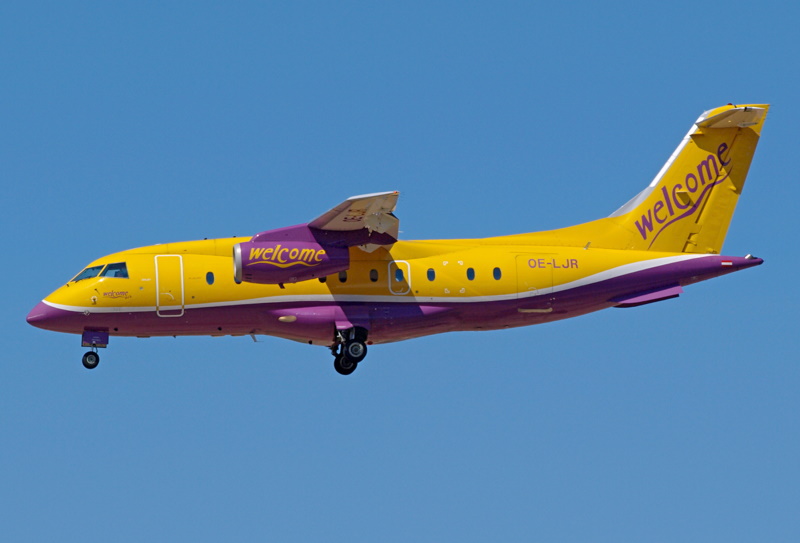
Although the Do 328JET looked very much like a Do 328 with a turbofan set forward under each wing on a pylon, there were various detail changes in the airframe to accommodate the new propulsion and improved performance; for example, the wing-fuselage fairings were cleaned up to deal with buffeting. The flaps were also extended, increasing the wing chord.
   ___________________________________________________________________

   DORNIER DO 328-110:
   ___________________________________________________________________

   wingspan:
     20.98 meters (68 feet 10 inches)
   wing area:
     40 sq_meters (430.6 sq_feet)
   length:
     21.28 meters (69 feet 10 inches)
   height:
     7.24 meters (23 feet 9 inches)

   empty weight:
     9,200 kilograms (20,280 pounds)
   max operating weight:
     14,990 kilograms (33,050 pounds)

   max cruise speed:
     740 KPH (460 MPH / 400 KT)
   service ceiling:
     7,620 meters (25,000 feet)
   range, normal payload:
     1,665 kilometers (1,035 MI / 900 NMI)

   ___________________________________________________________________
A total of 83 Do 328JETs was sold up until 2002, when Fairchild-Dornier went bankrupt. Work had been in progress on a stretched "Do 428JET" with 44 passenger capacity, with more ambitious concepts for a new-design family of larger regional jetliners designated the "Do 728JET", "Do 828JET", and "Do 928JET" with capacity for about 70, 80, or 90 passengers respectively -- but they never flew. Rights to Fairchild-Dornier aircraft production were purchased by Avcraft of the US, but Avcraft then went bankrupt itself in 2005.
That wasn't quite the end of the Do 328JET. In 2007 Lockheed Martin of the US was awarded a contract by the US Air Force Research Laboratory (AFRL) to build an "Advanced Composite Cargo Aircraft (ACCA)" demonstrator, intended to explore the use of advanced carbon-composite construction techniques for future cargo aircraft. Lockheed Martin chose to use a recycled 328JET as the basis for the demonstrator, effectively chopping off the wings and front fuselage of the 328JET and mating them to a new fuselage and tail.
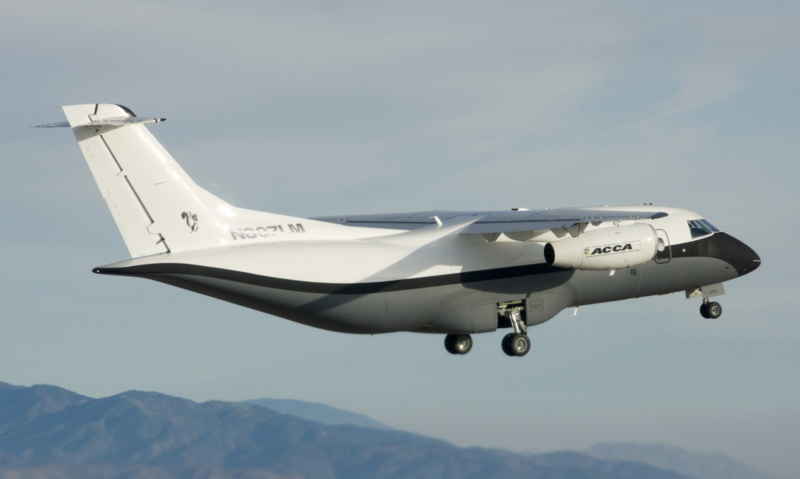
The new ACCA configuration featured main landing gear in sponsons and a high tail with a rear loading ramp. Initial flight of the ACCA was on 2 June 2009, with the machine given the designation of "X-55A" later in the year. The "Carbon Comet" as it was named, was strictly a technology demonstrator, not a prototype of an operational machine; it completed trials and was retired in 2014. There have been motions towards putting the 328Jet back into production, but nothing definite has happened yet.
BACK_TO_TOP* The line of civil aircraft begun with the Dornier Do 27 had an interesting evolution, progressing with varying degrees of inheritance through the Do 28A, the Do 28D, the Model 128, the Model 228, the Model 328, and the Model 328Jet. Early on, there was also a side branch of the basic Do 27 in the form of the experimental "Do 29" STOL aircraft.
The Do 29 traced its ancestry back to a STOL aircraft concept drawn up by Dr. Heinrich Focke during World War II, designated the "Focke-Achgelis 269 (FA 269)". The FA 269 looked like a conventional fixed-wing aircraft, but it had a pusher propeller on each wing that would be tilted downward for take-offs and landings. The aircraft featured stretched tailwheel landing gear to provide prop clearance.
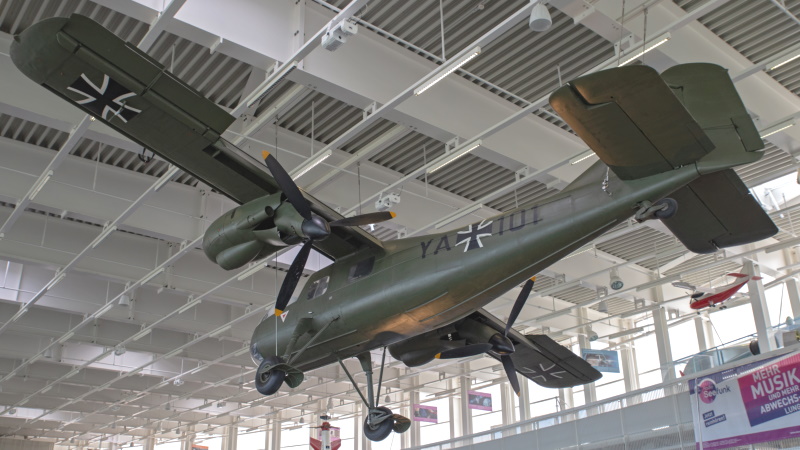
The FA 269 never got much further than a "back of the envelope" design, but in the mid-1950s the West German Ministry of Defense worked with Dornier to come up with a real-world implementation of the concept, with the company altering the Do 27 design appropriately as the Do 29. The engine was yanked from the nose, with extensive cockpit glazing installed forward to give a helicopter-like view, and the main landing gear was lengthened considerably. A Lycoming GO-480 flat-six engine was installed in a pod under each wing, driving a three-bladed pusher prop that could be hinged downward 90 degrees -- though photos of the Do 29 in operation never show them vectored to more than 60 degrees off the centerline. The props turned in opposite directions to counter torque effects, and there was a power coupling between the two engines that permitted both props to keep turning if one engine failed.
Initial flight of the first of three Do 29s built was in December 1958. The Do 29 unsurprisingly had very good short-field performance, with a stall speed of only 24 KPH (15 MPH); it could easily take off and land in a stone's throw. No production machine followed from the exercise, however. The first Do 29 still survives in a museum in Germany.
BACK_TO_TOP* Sources include:
Clarifications were obtained from Dr. Stephan Kreipl and Martin Rulffs' Do 27 website.
* Illustrations details:
* Revision history:
   v1.0.0 / 01 apr 10
   v1.0.1 / 01 nov 10 / Minor fixes.
   v1.0.2 / 01 oct 12 / Do 328 in SOCOM service, orders for Do 228NG.
   v1.1.0 / 01 sep 14 / AFSOC Wolfhound.
   v1.2.0 / 01 aug 16 / Sierra Nevada 328Jet production plans.
   v1.2.1 / 01 jul 18 / Review, update, & polish.
   v1.2.2 / 01 jun 20 / Review, update, new illustrations.
   v1.3.0 / 01 apr 22 / Added hydrogen Do 228s and DO 328eco.
   v1.3.1 / 01 mar 24 / Review & polish. (+)
BACK_TO_TOP
