
* Given the wide use and utility of the Mirage III series, it was not surprising that derivatives were built, either as new production or rebuilds, in several user countries -- most notably in the form of the Israeli "Kfir" and the South African "Cheetah". The French also built experimental vertical take-off aircraft based on the Mirage III.
* Dassault had developed the Mirage 5 at the request of the Israelis. When the French government prevented the aircraft from being delivered to Israel and cut off support for the Israeli's existing Mirage IIICJ fleet, the Israelis simply produced the Mirage 5 themselves without a license, using manufacturing specs obtained by Israeli intelligence. There is an elaborate cloak-and-dagger story behind this exercise that doesn't quite eliminate the suspicion that the Israelis were very discreetly helped by Dassault in this effort, the French government turning a blind eye to the whole matter. If so, nobody's ever been able to prove a thing.
The "Nesher (Eagle)" was a complete copy of the Mirage 5, except for the use of some Israeli avionics; a Martin-Baker zero-zero ejection seat; and provisions for a wider range of AAMs, including the Israeli Shafir heat-seeking missile. The first Israel Aircraft Industries (IAI) Nesher prototype flew in September 1969, with production deliveries to the Hey'l Ha'Avir beginning in 1972. These aircraft performed well during the 1973 Yom Kippur / Ramadan War, claiming over a hundred kills.
51 Nesher fighters and 10 Nesher two-seat trainers were built in all. As mentioned, most of these aircraft were refurbished and exported to Argentina in 1978:82, under the name "Dagger". The Argentinians received 35 "Dagger A" single-seat fighters and 4 "Dagger B" two-seat trainers. The last of them were retired in 2015.
* Nesher production was terminated to make way for an improved Mirage derivative that had been in planning in parallel, in which the Atar engine was to be replaced with an Israeli-built General Electric J79 engine, the same engine used on the American F-104 Starfighter and F-4 Phantom fighters. The J79 provided a dry thrust of 49 kN (5,000 kgp / 11,100 lbf) and an afterburning thrust of 83.4 kN (8,500 kgp / 18,750 lbf).
The J79 was first fitted to a French-built Mirage III, flying in October 1970. This test aircraft was followed by an improved prototype in June 1973, with the name "Raam (Thunderbolt)". Apparently a number of Mirage III-based J79-powered aircraft were built by IAI under the name "Barak (Lightning)" and participated in the 1973 Yom Kippur war, but making the most of the new engine meant airframe changes.
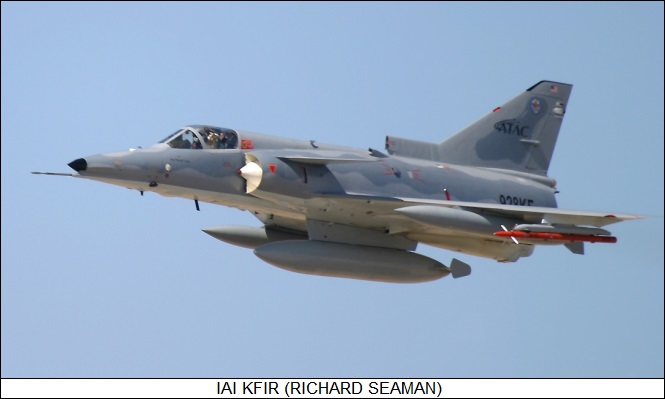
Production deliveries of an optimized J79-powered Mirage derivative, under the name "Kfir-C1 (Lion Cub)", began in April 1975. The Kfir-C1 superficially resembled a Mirage 5, except for a distinctive "ram" air inlet at the front base of the tail to provide added cooling required by the J79 engine.
Only 27 Kfir-C1 fighters were delivered, to be replaced by the improved "Kfir-C2". The Kfir-C2 had a number of enhancements to traditional Mirage aerodynamics. It featured narrow "strakes" along the tip of the nose; fixed detachable canards; and an extended "dogtooth" outer wing. The aerodynamic improvements gave the Kfir better combat maneuverability, reduced landing and take-off distance, and improved low-speed handling.
   ___________________________________________________________________

   IAI KFIR:
   ___________________________________________________________________

   wingspan:
     8.21 meters (27 feet)
   wing area:
     34.80 sq_meters (374.6 sq_feet)
   length:
     15.65 meters (51 feet 4.25 inches)
   height:
     4.55 meters (14 feet 11.5 inches)

   empty weight:
     7,285 kilograms (16,060 pounds)
   max loaded weight:
     14,670 kilograms (32,340 pounds)

   maximum speed:
     2,440 KPH (1,520 MPH / 1,320 KT)
   service ceiling:
     17,700 meters (58,000 feet)
   operational radius:
     770 kilometers (480 MI / 420 NMI)

   ___________________________________________________________________
All but two of the Kfir-C1s were upgraded to the Kfir-C2 configuration, though they used smaller canards because of structural issues. 185 Kfir-C2s were built, including a number of "Kfir-TC2" two-seat trainers. The trainer versions are very unusual looking, since they have an extended nose containing avionics displaced by the second seat, and the nose was noticeably drooped to give a reasonable cockpit view. The result was a somewhat comical "big nose" appearance.
Final production Kfirs, delivered in the late 1980s, featured nine stores pylons, upgraded avionics, and other refinements, and were designated "Kfir-C7" and "Kfir-TC7". The Kfirs carried Israeli-built weapons, such as the Shafir II and follow-on Python 3 heat-seeking missiles, and US-built weapons, such as Maverick air-to-ground and Shrike anti-radar missiles.
* In 1991, IAI introduced an upgraded Kfir-C2, known as the "Nammer (Tiger)", for the export market. This aircraft had a slightly stretched fuselage; modern avionics, including multifunction displays (MFDs) and "hands on throttle and stick (HOTAS)", controls, and the ability to accommodate either a SNECMA Atar 9K-50 turbojet or a GE-Volvo F404 / RM12 turbofan. Apparently the use of the J79 engine led to American export restrictions on the type that the chafed on the Israelis, so they went to a different engine fit. Along with the usual twin 30-millimeter cannon, the Nammer had nine stores pylons and could carry up to 6.25 tonnes (13,800 pounds) of external stores. It also had provision for in-flight refueling.
There were no takers for the Nammer as such, but IAI didn't give up, offering the "Kfir-C10/TC10" as an upgrade, with a modern Israeli Elta EL/M-2021B multimode radar, twin MFDs, HOTAS, a modern countermeasures suite, and compatibility with the latest guided munitions. There was also a "Kfir-C12/TC12", much the same except without the new radar. In 2013, IAI announced a further improved "Block 60" Kfir update, the centerpiece being the Elta EL/M-2032 multimode active-array radar, with the company having a stockpile of 50 mothballed airframes in good condition to upgrade.
Kfirs were withdrawn from Israeli service during the 1990s, most being passed on to foreign users after refurbishment. Export sales included:
* South Africa performed an update to their Mirages along the lines of that of the Kfir and incorporating some Israeli-built kit. In 1986, Atlas Aircraft Corporation of South Africa rolled out a refurbished Mirage III machine named the "Cheetah". Improvements to the Cheetah featured:
Not all Cheetahs incorporated all these improvements, with the variations detailed later. The updated avionics kit included:
The Cheetah was qualified to carry locally-built South African weapons, such as the Kukri and Darter AAMs, which could be cued by the pilot's helmet-mounted sight, along with Israeli weapons such as the Python AAM. The Cheetah's radar was not capable of supporting long-range radar-guided AAMs. Of course, operational Cheetahs retained the twin DEFA cannon and could carry such ordnance as conventional bombs, cluster munitions, and unguided rocket pods. The result of all the modifications was something like a Kfir without the J79 engine fit, resembling a Kfir except for the lack of a ram-air inlet at the base of the tail.
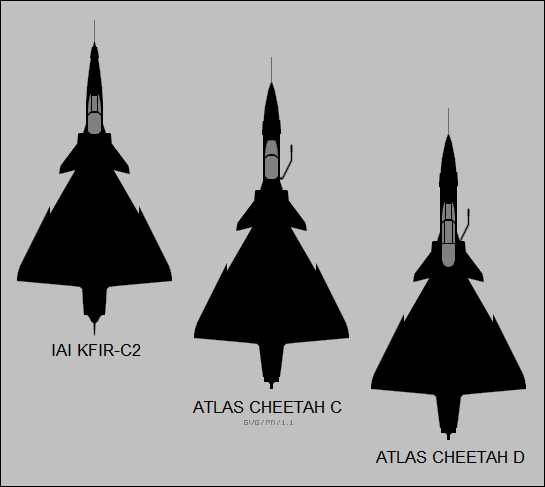
Atlas updated a quantity of Mirages, apparently including both South African machines and some obtained quietly from Israel and possibly some other foreign sources, to the Cheetah standard, with variants including:
There was some interest in re-engining the Cheetahs with Russian Klimov RD33-type turbofans, similar to the engines used on the MiG-29, and one Cheetah D was fitted with the Klimov engine on a trial basis. However, South Africa updated their fighter force with the Swedish SAAB 39 Gripen lightweight fighter, and all Cheetahs are now out of service.
Twelve Cheetahs, including 10 Cheetah C and 2 Cheetah D machines, were sold to Ecuador, to be refurbished and delivered in late 2011. Two attrition replacements were obtained in 2014. They were finally withdrawn in 2021.
In 2018, Draken International -- a US firm that, like ATAC, flies warbirds under military contract for adversary training obtained 12 Cheetahs, including 9 Cheetah C and 3 Cheetah D machines, with these machines refurbished and fitted with upgraded avionics.
* The Chilean company ENAER (Empresa Nacional de Aeronatica) performed a similar Kfir-C2-like upgrade under the name "Pantera (Panther)" of the Chilean Mirage 50 fleet, beginning in 1988. The Pantera incorporated fixed canards and other aerodynamic improvements, as well as advanced avionics. These aircraft had an extended nose to accommodate some of the new avionics. They were all retired by 2007.
BACK_TO_TOP* One of the most interesting offshoots of the Mirage III/5/50 fighter family tree was the "Mirage IIIV" vertical take-off and landing (VTOL) fighter. "IIIV" is read "three-vee", not "three-five", by the way. This aircraft featured eight small vertical lift engines straddling the main engine. The Mirage IIIV was built in response to a mid-1960s NATO specification for a VTOL strike fighter.
To test the lift-engine concept, Dassault modified the first Mirage III prototype. Eight Rolls-Royce RB-108 lift engines were added, each with 9.61 kN (980 kgp / 2,160 lbf) thrust. This demonstrator was known as the "Balzac V", with the "V" for "VTOL", or just "Balzac". It made its first hover flights in October 1962, with its first transition from vertical to horizontal flight in March 1963. The name "Balzac" was not actually given to the aircraft in honor of the French literary figure. Since the machine was the first Mirage III, it was serial-numbered "001", and at the time there was a French movie advertising agency that widely publicized its phone number, "BALZAC 0001".
The Balzac crashed in January 1964. The pilot was killed, but the aircraft was repaired, only to crash again in September 1965, killing another pilot in the process. The aircraft was fortunately destroyed, ensuring it wouldn't kill another pilot.
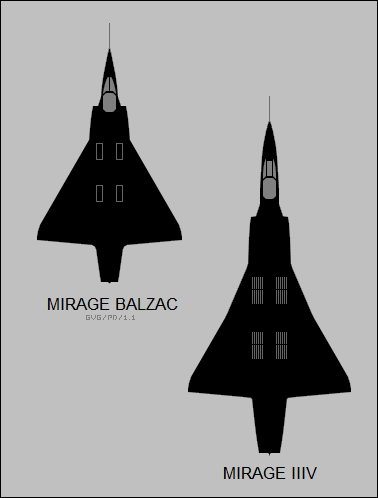
* In the meantime, the Balzac had led to the Mirage IIIV, which was twice as big. Two prototypes were built. The first Mirage IIIV performed its first hovering trial in February 1965. The IIIV had the general layout of earlier Mirage fighters, but it was longer and had a bigger wing, and, like the Balzac, nine engines: a single SNECMA-modified Pratt & Whitney JTF10 turbofan, designated TF-104, with 61.8 kN (6,300 kgp / 13,900 lbf) thrust, and eight Rolls-Royce RB162-1 engines, each with 15.7 kN (1,600 kgp / 3,525 lbf) thrust, mounted vertically in a row of four on each side of the centerline. The TF-104 was originally evaluated on a special-built trials machine, the "Mirage IIIT", which was much like a Mirage IIIC except for the change in engine fit.
The TF-104 engine was quickly replaced by an uprated TF-106 engine, with 74.5 kN (7,600 kgp / 16,750 lbf) thrust, before the first prototype made its initial transition to forward flight in March 1966. It later attained Mach 1.32 in test flights.
The second prototype featured an 82.4 kN (8,400 kgp / 18,500 lbf) thrust TF-30 turbofan for forward thrust, and first flew in June 1966. In September of that year, it attained Mach 2.04 in level flight, but was lost in an accident on 28 November 1966. The loss of the second prototype effectively killed the program, and in fact killed any prospect of an operational Mach 2 vertical take-off fighter for decades. The British had been proceeding on design work towards the "Hawker P.1154", a supersonic follow-on to the Kestrel experimental VTOL fighter then flying, but the French preferred the Mirage IIIV, and the international cooperation needed to make the P.1154 a reality never materialized.
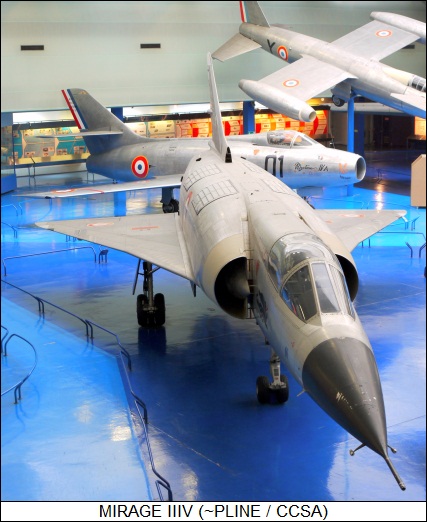
The British canceled the P.1154 and used some of its design features to come up with an operational vertical take-off fighter based on the Kestrel, the highly successful BAE Harrier. The Mirage IIIV was never a realistic combat aircraft. The eight lift engines would likely have been a maintenance nightmare, and certainly their weight imposed a severe range and payload penalty on the aircraft. Apparently the program was all but dead even before the loss of the second prototype.
BACK_TO_TOP* The history of the Mirage III and its derivatives is elaborate, and a * summary is useful to keep it all straight:
* Writing this document was troublesome, since there are so many minor variations on the Mirage III series, including rebuilds and even rebuilds of rebuilds, that keeping track was a major headache.
I have only seen a Mirage, or rather a pair of them, once, but it was memorable. I was stationed with the US Army in Germany in 1974:75 and was running through a vineyard one day when two of them roared over my head at low altitude. I can still clearly recall the image of their hot stovepipes and feel the roar of their Atar engines.
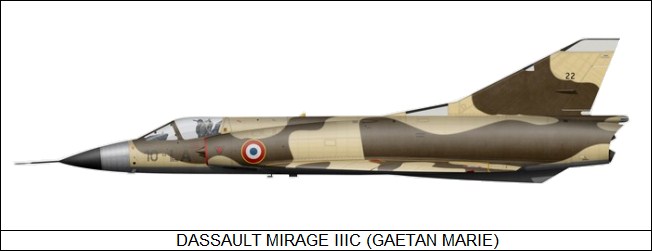
* Sources include:
* Revision history:
   v1.0   / 20 jul 97
   v1.1   / 22 sep 97 / Review & polish.
   v1.2   / 01 aug 98 / Review & polish.
   v2.0   / 01 apr 00 / Broke out materials, big update.
   v2.1.0 / 01 nov 02 / New illustrations, Cheetah, user list.
   v2.1.1 / 01 nov 04 / Review & polish.
   v2.1.2 / 01 nov 06 / Review & polish.
   v2.1.3 / 01 feb 09 / Review & polish.
   v3.0.0 / 01 aug 09 / Broke into two chapters.
   v3.0.1 / 01 jul 11 / Review & polish.
   v3.0.2 / 01 jun 13 / Review & polish.
   v3.1.0 / 01 may 15 / Kfir comments, dropped user list, added variant list.
   v3.1.1 / 01 apr 17 / Review & polish.
   v3.1.2 / 01 mar 19 / Review & polish.
   v3.1.3 / 01 jan 21 / Review & polish.
   v3.1.4 / 01 nov 22 / Review & polish.
   v3.1.5 / 01 oct 24 / Review & polish. (+)
The original versions of this document discussed the Mirage 2000 and Mirage IV. As of v2.0, these discussions were removed and set up as new stand-alone documents, while the original text on the Mirage III/5/50 was extensively rewritten.
BACK_TO_TOP