
* The Grumman S2F "Tracker" was one of the more prominent tools of Western naval power in the 1960s. This compact carrier-based aircraft provided a capable platform for ocean patrol and sub-hunting, and also served as the basis for the "Trader" transport and "Tracer" early-warning aircraft. This document provides a history and description of the Tracker, Trader, and Tracer -- as well as its predecessor in Navy service, the Grumman A2F "Guardian". A list of illustration credits is included at the end.
* The Grumman company developed a number of aircraft that made major contributions to Allied victory in World War II, one being the "TBM Avenger" torpedo bomber. In 1942, the US Naval Bureau of Aeronautics asked the Grumman company about a possible successor bomber. Further discussions led Grumman to initiate development of such a replacement in 1944, to be designated "XTB2F-1". The XTB2F-1 would eventually lead to the Guardian, but through a convoluted path.
The initial concept for the XTB2F-1 was for a multi-seat, carrier-based torpedo bomber with twin Pratt & Whitney (P&W) R-2800-22 Double Wasp radial engines. The XTB2F-1 would be able to carry up to 3,600 kilograms (8,000 pounds) of bombs or torpedoes, and would have an extremely long range of up to 5,950 kilometers (3,700 miles). Unfortunately, the XTB2F-1 proved far too ambitious: the design was simply too big and heavy to be flown off most of the US Navy's aircraft carriers. The XTB2F-1 was canceled in January 1945 in favor of a more conservation option, a derivative of the Grumman F7F Tigercat twin-engine fighter designated the "XTSF-1".
Grumman had also been working on a third design, with the company designation "G-70", for several months, and the Navy found the G-70 attractive. In February 1945 the service decided to abandon the XTSF-1, awarding a contract to Grumman for three G-70 prototypes, with the Navy designation "XTB3F". Two of the prototypes would be "XTB3F-1s" and the third would be an "XTB3F-2". They were to be "mixed-power" aircraft, with a P&W R-2800-6 Double Wasp, providing 1,715 kW (2,300 HP) and fitted in the nose; plus a turbojet fitted in the tail, fed by oval intakes in the leading edges of the wings. The turbojet was to be used to provide boost power for take-offs and combat emergencies.
The XTB3F-1 would be fitted with a Westinghouse 19XB-2B turbojet, while the XTB3F-2 was to be fitted with a Westinghouse 24C-4B turbojet. The two aircraft were otherwise similar, featuring a crew of two, sitting side-by-side; a warload of up to 1,800 kilograms (4,000 pounds) of bombs, torpedoes, or rockets; and twin fixed forward-firing 20-millimeter cannon.
* The initial XTB3F-1 prototype flew on 19 December 1945, with Grumman test pilot Pat Gallo at the controls. The turbojet intakes were masked off because of problems encountered in ground tests; in fact, the jet engine proved to be a bad idea, and was quickly removed without ever being lit up in flight.
On 24 December, the Navy decided that they no longer needed a new torpedo bomber -- it was a generally obsolete concept by that time -- and told Grumman that they wanted a carrier-based antisubmarine warfare (ASW) aircraft instead. The Navy's mainstay in that role was an ASW modification of the Avenger, but something better was desired. There was no way at the time to cram all the necessary ASW gear into a single aircraft, and so two variants of the "Guardian", as it was named, were planned, with the pair to act as a "hunter-killer" team.
The two unbuilt prototypes were adapted towards this end. The single XTB3F-2 prototype was built as the "hunter" member of the team -- without the Westinghouse turbojet engine, but with two more seats for radar operators plus a large ventral radome fitted where the bomb bay had been, accommodating AN/APS-20 ocean search radar. This aircraft became the "XTB3F-1S", and first flew on 1 October 1948. The second XTB3F-1 prototype was built as the "killer" member of the team, retaining the bomb bay but deleting the cannon, adding a third seat, and being fitted with a searchlight as well as short-range radar. This aircraft became the "XTB3F-2S" and first flew in January 1949, with both aircraft performing naval flight tests in February.
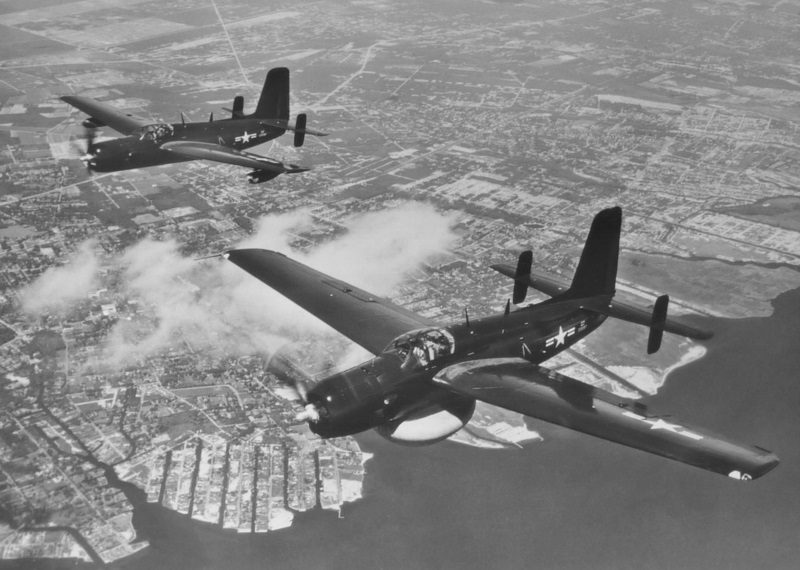
By this time, the Guardian had already been ordered into production. The XTB3F-1S "hunter" was built as "AF-2W" (originally "AF-1S"), and the XTB3F-2S "killer" was built as the "AF-2S". The first production AF-2S Guardian flew on 17 November 1949. Qualification trials were conducted from May 1950 through November 1951, with the first operational aircraft going into service in October 1950.
* The Guardian was a brute of an aircraft, said to be the biggest single-engine piston aircraft ever flown by the US Navy. It was driven by a P&W R-2800-48W Double Wasp radial engine, providing 1,790 kW (2,400 HP) to an oversized four-bladed propeller.
The aircraft had taildragger landing gear, the main gear retracting outward into the wings, with a stinger-type arresting hook aft of the tailwheel. It had wide-span mid-mounted wings that folded back towards the tail in classic Grumman fashion, outside of the main landing gear. The tail was of conventional configuration, except for secondary vertical "finlets" mounted a little beyond the midpoint of each tailplane.
The AF-2W "hunter" or "guppy" member of the team had a crew of four and was unarmed, though it could carry underwing drop tanks, and had a large radome for the AN/APS-20 search radar mounted on the belly under the cockpit. The finlets were to provide yaw stability, which was affected by the radome. 153 AF-2W Guardians were built.
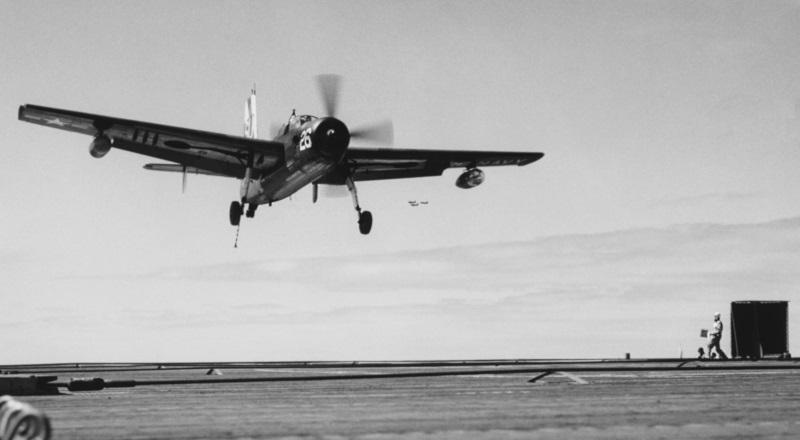
The AF-2S "killer" or "scrapper" member of the team had a crew of three and could carry up to 1,800 kilograms (4,000 pounds) of munitions, including depth charges, bombs, or a homing torpedo in the bomb bay; fuel tanks or other stores on an underwing pylon inboard on each wing; and six 12.7-centimeter (5-inch) "high velocity aircraft rockets (HVAR)" mounted on underwing stubs. It could also drop sonar buoys ("sonobuoys"), either from the bomb bay or from an underwing pod. The AF-2S mounted AN/APS-30 targeting radar in a pod under the right wing and a searchlight in a pod under the left wing. The AF-2S retained the tail finlets -- though whether they were actually necessary, or were simply there to ease production, is an interesting little question. 193 AF-2S Guardians were built.
   ___________________________________________________________________

   GRUMMAN AF-2S GUARDIAN:
   ___________________________________________________________________

   wingspan:
     18.5 meters (60 feet 8 inches)
   wing area:
     51 sq_meters (549 sq_feet)
   length:
     13.2 meters (43 feet 4 inches)
   height:
     4.93 meters (16 feet 2 inches)

   empty weight:
     6,615 kilograms (14,580 pounds)
   max loaded weight:
     11,340 kilograms (25,000 pounds)

   maximum speed:
     507 KPH (315 MPH / 275 KT)
   service ceiling:
     9,900 meters (32,500 feet)
   range:
     2,415 kilometers (1,500 MI / 1,305 NMI)

   ___________________________________________________________________
A second version of the AF-2S hunter was built beginning in 1952, featuring "magnetic anomaly detector (MAD)" gear with a boom that extended from a fairing mounted on the right side of the rear fuselage. The MAD gear greatly improved the Guardian's ability to find and track subs. This variant was designated the "AF-3S", and 40 were built. The last Guardian was rolled out in March 1953, with a total of 389 of all variants built, including the prototypes.
The Guardian was somewhat underpowered, an unpleasant feature for a carrier aircraft that had to make short take-offs, and its pilots found its controls heavy. Its accident rate was on the high side -- by modern standards the unacceptably high side, but in an era when combat aircraft were cheaper and more common, accident rates that would be completely outrageous now were regarded as acceptable.
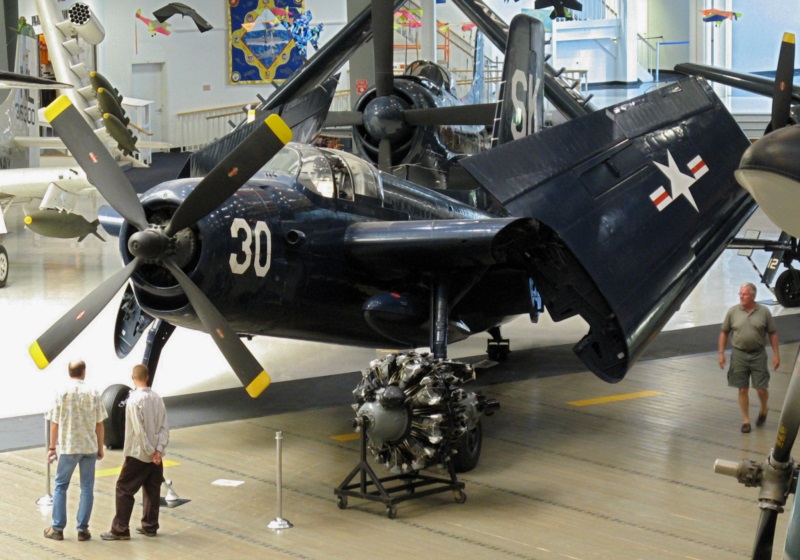
Although the Guardian conducted war patrols in Korean waters from March 1951 through May 1953, it did not remain in service for long after that; the last Guardian was retired from first-line service on 31 August 1955. Guardians remained in service with Navy Reserve squadrons into 1957. A number of Guardians ended up in civilian hands and were often used as "water bombers", with a water / retardant tank in a ventral tub, and some of these aircraft are now on static display in museums. For example, one AF-2S is on show at the Naval Aviation Museum in Pensacola, Florida. No Guardians remain in flightworthy condition.
BACK_TO_TOP* The Guardian was an interim aircraft in the carrier ASW role; the Navy had begun work on a much better successor even before the AF entered operational service. On 30 June 1950, the US Navy awarded Grumman a contract to develop a twin-engine carrier-based aircraft that could perform all the functions of the Guardian duo.
The contract specified development of two prototypes of the Grumman "Model 89", with the initial military designation of "XS2F-1 Sentinel". The XS2F-1 was to carry a full complement of ASW sensors and weapons, and fly with good cruising speed over a range of up to 1,600 kilometers (1,000 miles).
The first of two XS2F-1 prototypes performed its initial flight on 4 December 1952. Following trials of 15 "YS2F-1" service evaluation machines, the production "S2F-1" entered US Navy service in February 1954, with Squadron VS-26. The S2F-1 was much like the XS2F-1 prototypes, but had uprated Cyclones providing 1,138 kW (1,525 HP) each. After service introduction, the type was renamed "Tracker". Although aircraft nicknames are something of a treacherous subject, occasionally being fabrications well after the fact, it does appear that the Tracker eventually became known as the "Stoof", a corruption of the "S-Two-F" designation.
The S2F-1 was a high-wing monoplane with a rounded, roomy fuselage, powered by twin Wright R-1820-82WA Cyclone nine-cylinder air-cooled radial engines providing 1,138 kW (1,525 HP) each, mounted in long nacelles on the wings. The engines drove three-bladed variable-pitch Hamilton Standard props with square tips. The XS2F-1's Cyclones had slightly lower power ratings of 1,120 kW (1,500 HP) each. The S2F-1's long wings and powerful engines allowed it to operate from small carriers and short airfields. The wings folded up hydraulically over the top of the aircraft, with the wing fold "skewed" so the two wings would overlap each other when folded. The S2F-1 had tricycle landing gear, with twin-wheel nose gear, along with single-wheel main gear retracting backwards into the engine nacelles. The aircraft was fitted with a stinger-type arresting hook, preceded by a small tailwheel to act as a bumper on carrier landings.
The S2F-1's ASW fit included:
The S2F-1 carried a crew of four, with the pilot on the left front of the cockpit, co-pilot / navigator on the right, and two systems operators in the rear. The cockpit was unpressurized. Crew entry was through a hatch on the left side of the fuselage forward of the wing, with an escape hatch above each front seat, and two hatches in the belly -- it seems for service access. The aircraft carried a four-man inflatable life raft, probably stowed in a compartment on top of the fuselage or wings. With no engine in the nose, the forward view was much better than that of the Guardian.
The S2F-1 had an internal fuel capacity of 1,970 liters (520 US gallons). Total weapons load was up to 2,180 kilograms (4,800 pounds), including a single homing torpedo in the weapons bay, plus depth charges, rockets, bombs, or other stores fitted to six underwing pylons. Early on, Trackers were painted in overall Sea Blue, but eventually the Navy went to a color scheme of Gull Gray, topside, and Gloss White on the bottom.
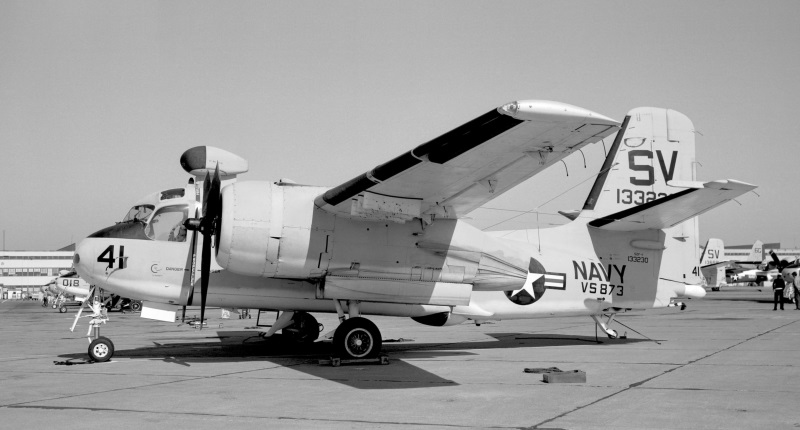
A total of 740 S2F-1s was built by Grumman, not counting the YS2F-1 evaluation machines, with de Havilland of Canada (DHC) building an additional 44 "CS2F-1" machines -- with minor differences in equipment fit, such as replacing the teardrop antenna above the cockpit with a different antenna fit, possibly the same as that on early S2F-1s. The S2F-1 / CS2F-1 was built in larger quantities than all successive variants and derivatives of the type combined. The S2F-1 was redesignated "S-2A" when the Pentagon went to a common designation scheme in 1962.
The US Navy relied heavily on the Tracker for fleet defense, and took measures to keep the type up to date. Many USN S2F-1 Trackers were retrofitted with the AN/AQA-3 "JEZEBEL" acoustic search (passive sonar) and "JULIE" echo-ranging (active sonar) gear, and redesignated "S2F-1S" (later "S-2B"). The JULIE system involved fitting ejector tubes for echo-sounding explosive charges in the bottom of the rear fuselage. A number of S2F-1S Trackers were further updated with an improved JULIE system, and designated "S2F-1S1 (S-2F)".
* S2F-1 series aircraft were generally phased out of first-line service as improved Tracker variants were introduced. The next production model, the "S2F-2 (S-2C)", featured a protruding and offset weapons bay to accommodate an oversized nuclear depth charge, plus stronger stores pylons to carrier heavier munitions, and a wider tailplane to compensate for the aerodynamic changes. The swollen weapons bay gave the S2F-2 a slightly pregnant look. Initial deliveries to the Navy were in late 1954.
A total of 77 S2F-2s was built by Grumman, with an additional 55 "CS2F-2" machines built by DHC. The CS2F-2 machines were not actually the same as the S2F-2, retaining the airframe of the CS2F-1, but with updated with new avionics. They notably had a small antenna fairing on top of the cockpit, plus antennas in the wingtips.
* Following the S2F-2, the "G-121 / S2F-3" first flew on 21 May 1959, and featured:
The S2F-3 was bigger overall to provide more crew space, fuel capacity, and equipment load. The S2F-3 entered fleet service in May 1961.
Since more compact nuclear depth charges had been developed, the weapons bay was shrunk back to its original size. The ECM antenna fairing on top of the cockpit was removed, replaced by an improved ECM system using antennas fitted into the wingtips, and most of the other electronics systems were modernized as well. Stores pylons were strengthened, and the sonobuoy compartments at the end of the nacelles were noticeably enlarged to increase sonobuoy capacity from 8 to 16 in each nacelle. 100 S2F-3s were built in all, with introduction to service in 1960.
   ___________________________________________________________________

   GRUMMAN S2F-3 TRACKER:
   ___________________________________________________________________

   wingspan:
     22.12 meters (72 feet 7 inches)
   wing area:
     46.08 sq_meters (496 sq_feet)
   length:
     13.26 meters (43 feet 6 inches)
   height:
     5.05 meters (16 feet 7 inches)

   empty weight:
     8,500 kilograms (18,750 pounds)
   max loaded weight:
     13,220 kilograms (29,150 pounds)

   maximum speed:
     426 KPH (265 MPH / 230 KT)
   service ceiling:
     6,400 meters (21,000 feet)
   range:
     2,090 kilometers (1,300 MI / 1,130 NMI)
   endurance:
     9 hours

   ___________________________________________________________________
The Canadians updated their Tracker fleet to "CS2F-3" standard between 1964 and 1968, adding improvements such as JULIE-JEZEBEL; they were not the same as the S2F-3. All Canadian Trackers were redesignated "CP-121" in 1968, when Canadian forces were unified. From 1973, they were generally converted to the maritime patrol role, deleting ASW equipment but retaining search radar, and could drop rescue packs from underwing pylons.
The final production variant of the Tracker was the "S2F-3S (S-2E)", essentially an S2F-3 with JULIE-JEZEBEL gear and a TACAN radio navigation beacon receiver system. The SDF-3S was introduced in 1962, with the last of 252 machines delivered in 1968. A total of 1,285 Trackers had been built in the US and Canada.
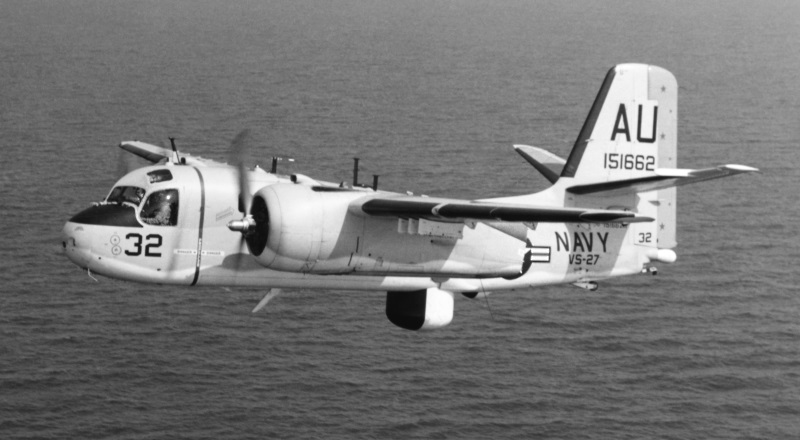
60 S2F-3S machines were upgraded to "S-2G" standard, featuring the AN/AQA-7 DIFAR sonobuoy data processor, plus a three-tube smoke marker ejector on the lower side of the right engine. The first S-2G was redelivered in 1972.
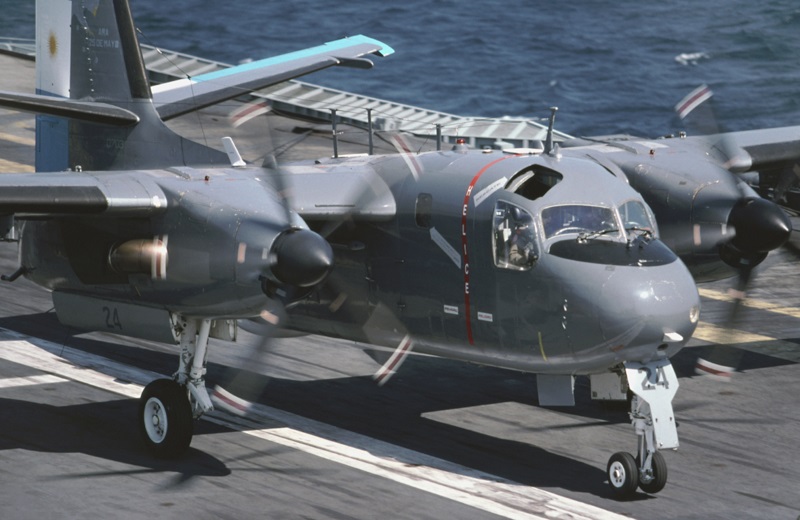
* A total of 20 US Navy squadrons was ultimately equipped with the Tracker. The type also did very well on the international market, with help from the US Military Assistance Program, being supplied to Argentina, Australia, Brazil, France, Italy, Japan, the Netherlands, Taiwan, Thailand, Turkey, and Uruguay.
BACK_TO_TOP* With such a large number of Trackers built, to no surprise, many airframes were modified for other purposes:
* The Tracker served with the US Navy with quiet distinction during the 1960s. Along with its primary role to protect the fleet from Soviet submarines, it was used for maritime patrol during the Vietnam War, assisting in rescues of aircrew downed at sea and occasionally engaging North Vietnamese patrol boats using unguided rockets, fired from underwing pods. One was lost in combat operations -- simply disappearing, to never be seen again. The Tracker's non-combat losses were also low, and in fact it had an enviable safety record.
The Tracker was replaced by the Lockheed S-3 Viking in US Navy ASW service in the 1970s, with the Tracker lingering in secondary roles into the mid-1980s. The type remained in use with a number of international air arms for much longer. Although it was obsolete in the ASW role by the time it ended production, it was still an effective aircraft for maritime patrol to monitor surface shipping -- though few, if any, are still flying in military service.
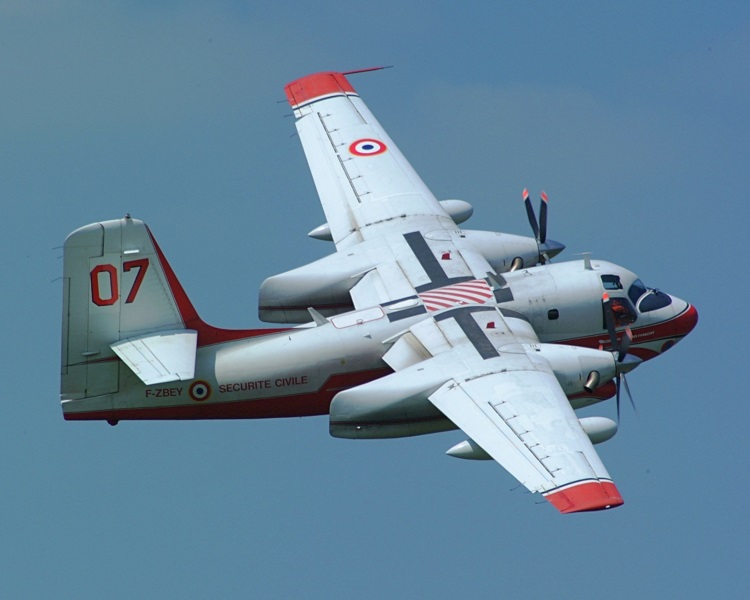
It remains in use as a popular "water bomber" or "air tanker" to fight forest fires, with Trackers modified to carry 3,032 liters (800 US gallons) of fire retardant. One of the primary users is the California Department of Forestry (CDF), but other Tracker water bomber conversions have been performed for Canada and Turkey. Although the Tracker is a capable and rugged aircraft, its stubby fuselage does make it difficult to handle in turbulence, particularly after retardant release, and a number of CDF pilots have lost their lives in crashes. It appears the CDF Trackers are still in service.
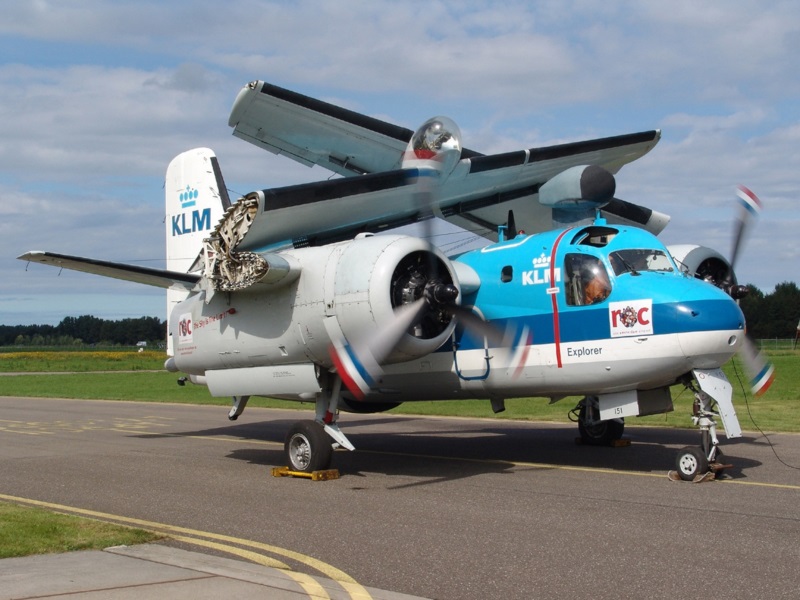
The old Wright Cyclones were too old to be used in normal operations any longer, and so "Turbo Tracker" conversions became popular. The engines of choice were the Garrett TPE331 or the Pratt & Whitney Canada (PWC) PT6A turboprop, both typically rated at 1,225 kW (1,645 SHP), with conversions performed by a number of companies:
While Trackers had long airframe lives, a tribute to the traditional ruggedness of Grumman designs, military Turbo Tracker conversions were not as popular as expected. Older versions of the P-3 Orion became available on the international used-aircraft market, and buyers preferred the more capacious and longer-legged Orion over the Tracker. It seems unlikely there will be more Turbo Tracker conversions, though those in service are likely to remain flying for some time.
BACK_TO_TOP* In 1955, Grumman flew the prototype of the "G-96 / TF-1 Trader" "carrier onboard delivery" (COD) derivative of the Tracker. The Trader featured a modified fuselage, but was otherwise parts-compatible with the Tracker. The Trader could be fitted with easily-removed seats for nine passengers, and included front and rear sliding bulkheads mounted on rails, plus removeable posts, to secure cargo for carrier landings. Maximum cargo capacity was 3,855 kilograms (8,500 pounds). Life rafts were fitted into the rear of the engine nacelles.
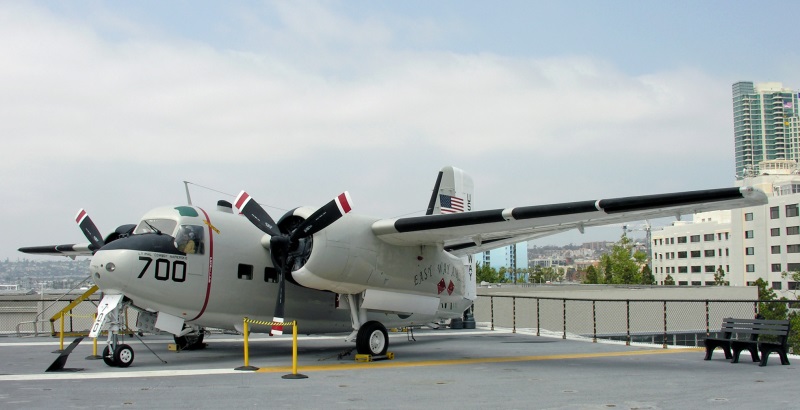
First flight of the Trader was in January 1955, with initial service delivery in 1957. A total of 87 was built from 1955 into 1958, including four fitted for the EW role and given the designation "TF-1Q". In 1962, the TF-1 was given the new designation of "C-1A", and the TF-1Q was redesignated "EC-1A". The Trader served with three US Navy logistics support and transport squadrons -- but it was strictly an interim type, being replaced by the Grumman C-2 Greyhound.
Some Traders ended up in civilian hands, and in 2011 the Brazilian Navy bought eight C-1As for use in the COD and tanker roles on the carrier SAO PAULO -- these machines apparently having been obtained from mothballed aircraft. They were to be refurbished, with modernized avionics, and re-engined with Honeywell TPE331 turboprops driving five-bladed props. However, the program ran into obstacles, and it didn't happen.
* The Trader led in turn to another Tracker derivative, the "G-117 / WF-2 Tracer" airborne early-warning (AEW) variant. The Tracer started life as a proposal to the Navy in 1951 for the "XWF-1", resulting in a contract for two prototypes of an AEW machine based on the Tracker -- but all that was built was a partial mockup, the program being canceled in 1953. The program was revived in 1955, with Grumman proposing an AEW aircraft based on the Trader instead of the Tracker. A Trader was used as an aerodynamic prototype, performing its initial flight on 17 December 1956. The first production WF-2 performed its initial flight on 1 March 1958, with a total of 88 built into 1961.
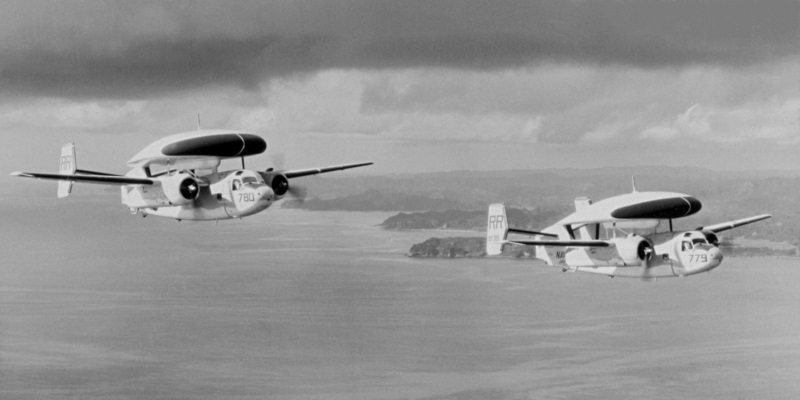
The Tracer featured a large dorsal "saucer" radome made of honeycomb fiberglass, with dimensions of 6.1 by 9.14 meters (20 by 30 feet), to accommodate the antenna for its Hazeltine AN/APS-82 search radar, and a new tail unit with three tailfins to compensate for the wake interference of the radome. Since the radome blocked the wings from folding upward, they were redesigned to fold backward along the fuselage in classic Grumman fashion.
   ___________________________________________________________________

   GRUMMAN WF-2 TRACER:
   ___________________________________________________________________

   wingspan:
     22.12 meters (72 feet 7 inches)
   wing area:
     46.08 sq_meters (496.0 sq_feet)
   length:
     13.82 meters (45 feet 4 inches)
   height:
     5.13 meters (16 feet 10 inches)

   empty weight:
     9,535 kilograms (21,025 pounds)
   max loaded weight:
     12,230 kilograms (26,970 pounds)

   maximum speed:
     385 KPH (240 MPH / 205 KT)
   cruise speed:
     265 KPH (165 MPH / 140 KT)
   service ceiling:
     4,800 meters (15,800 feet)
   range:
     1,665 kilometers (1,035 MI / 900 NMI)
   endurance:
     6.8 hours

   ___________________________________________________________________
The aircraft also featured an identification friend or foe (IFF) interrogator to determine if targets were friendly or hostile, plus a "Bellhop" system to transfer radar data to a surface vessel, and a communications relay transponder. The Tracer had a crew of four, including pilot, copilot, and two radar operators.
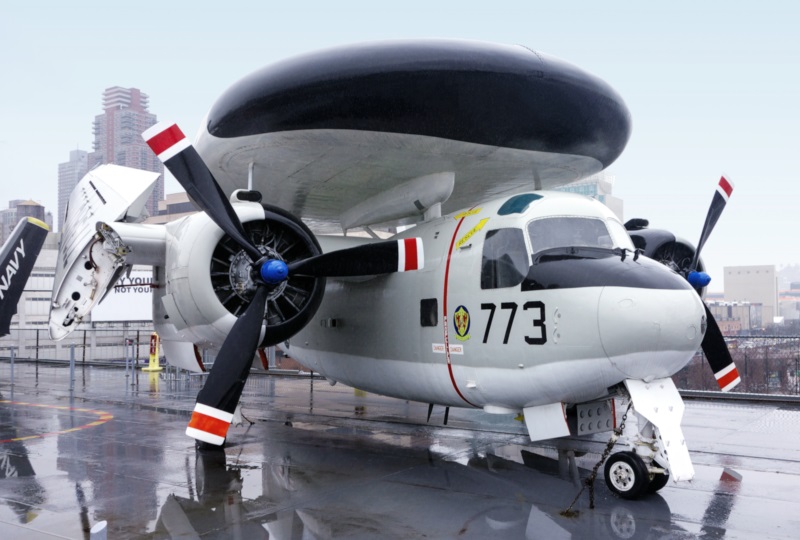
The Tracer was known as "Willie Fudd" by crews, in reference to its designation code, and sometimes as "Stoof With A Roof". The WF-2 was redesignated "E-1B" in 1962. The Willie Fudd saw extensive service in Vietnam. Like the Trader, the Tracer was an interim type, being replaced by the Grumman E-2 Hawkeye from the late 1960s, with the last Willie Fudd retired in 1977.
* The following summary list gives Tracker / Trader / Tracer variants, and production quantities:
As usual, there may be minor discrepancies in this count, but it can be regarded as well in the ballpark.
BACK_TO_TOP* One of the might-have-beens of the Tracker story was consideration of its use as a gunship in Vietnam. The idea wasn't ridiculous, the Lockheed P2V Neptune having seen some use as a "jungle fighter" in the conflict. The Air Force was looking for a "Self Contained Night Attack (SCNA)" platform that could locate targets on its own at night and engage them; the Tracker seemed to have the payload capability to do the job.
The gunship Tracker was to be designated the "AS-2D". It was to be fitted with "forward looking infrared (FLIR)" and "low light level TV (LLLTV)" imagers to acquire targets, with the Tracker's standard searchlight slaved to the LLLTV. Weapons were to consist of cluster munitions dispensers in the bomb bay, and stores carried on the underwing pylons. Two "YAS-2D" evaluation machines were planned, but the effort ran into technical and organizational difficulties, with the Air Force pulling the plug on the exercise in early 1968. It would have been interesting to see what the Tracker would have looked like in jungle camouflage.
* Sources include:
The "S-2F Tracker" website in the Netherlands was a significant source of information as well, and some minor details were obtained from the 1960 edition of JANE'S ALL THE WORLD AIRCRAFT. The information on Brazilian Trackers was provided by Captain Marcio Jansen Calvacanti of the Brazilian Navy.
* Illustrations credits:
* Revision history:
   v1.0   / 01 mar 01
   v1.0.1 / 01 jan 02 / Review & polish.
   v1.0.2 / 01 jan 04 / Review & polish.
   v1.0.3 / 01 jan 06 / Review & polish.
   v1.0.4 / 01 dec 07 / Review & polish.
   v1.0.5 / 01 jun 09 / AS-2D gunship comments.
   v1.0.6 / 01 may 11 / Review & polish.
   v1.0.7 / 01 apr 13 / Brazilian Traders.
   v2.0.0 / 01 jul 13 / Folded in AF Guardian.
   v2.1.0 / 01 jun 15 / Reorganization.
   v2.1.1 / 01 may 17 / Review & polish.
   v2.1.2 / 01 apr 19 / Review & polish.
   v2.2.0 / 01 may 21 / Illustrations update, modernization.
   v3.0.0 / 01 sep 22 / Substantial corrections.
   v3.0.1 / 01 jun 24 / Review & polish. (+)
The section on the AF Guardian started out as a separate document, the initial version being released in December 2000, with the writeup having reached version v1.0.6 before it was added to this document in July 2013.
BACK_TO_TOP
